Georgian & Neo-Classical Fireplaces - Westland London Antiques
Neoclassical & Georgian, including Adam and Palladian, English, Scottish, Irish & Italian antique fireplaces, mantels and chimneypieces in marble, stone and wood.
-
Stock: 6641
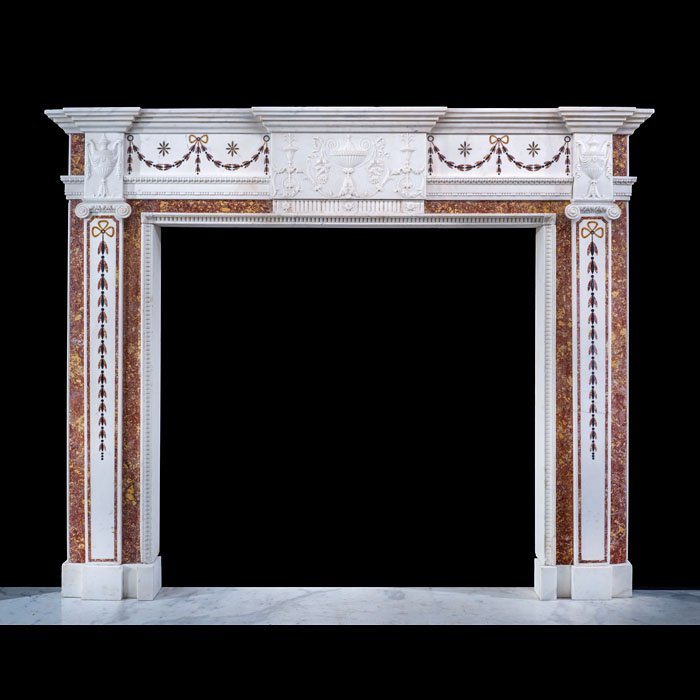
An exceptionally fine and rare George III neoclassical chimneypiece in statuary marble, inlaid with a warm brocatelle marble, attributed to makers of fine Georgian chimneypieces; the Darley Brothers of Dublin.
The crisply carved breakfront shelf rests over the frieze, which is beautifully inlaid with ribbon-tied bellflower swags and rosettes and with leaf and bead-and-reel carved mouldings between endblocks carved with urns atop Ionic-capped tapering pilasters. These are further inlaid with ribbon-tied bell-flower garlands framed by brocatelle marble panels with a leaf-carved and fluted inner slip, over slim footblocks.
Irish, c. 1780.
We can confidently attribute this chimneypiece to the workshop of George and Hill Darley. The duo operated as stone cutters in Dublin between 1757-1813. They left behind a collection of ninety drawings, considered to be the finest and most extensive collection of 18th century watercolour designs for chimneypieces. These watercolours most likely would have formed a catalogue of sorts, allowing clients to select a chimneypiece from numerous designs. Our example was almost certainly created from the drawing shown in the last image on this page, with subtle differences. With credit and thanks to the Digital Repository of Ireland for this image.
The Darley Collection of watercolours was donated to the Royal Irish Academy in 1889 by Sterling Ballantine.
This chimneypiece is almost certainly by the same hand as one in situ in the Library at Shropham Hall, Norfolk and illustrated in Jeremy Musson's article for Country Life, 24th February 2005, pp 76-80. Whilst not attributed to the Darleys, it bears a striking resemblance in design and construction.
Shelf is a 19th century replacement.
View our section showing the full range of our neo-classical chimneypieces
|
Width |
Height |
Depth |
| External |
76 1⁄2"
194.2 cms |
62 3⁄16"
158 cms |
6 3⁄8"
16.2 cms |
| Internal |
49 3⁄8"
125.6 cms |
49"
124.5 cms |
|
| Outer footblock |
72 3⁄8"
184 cms |
|
|
-
Stock: 6625
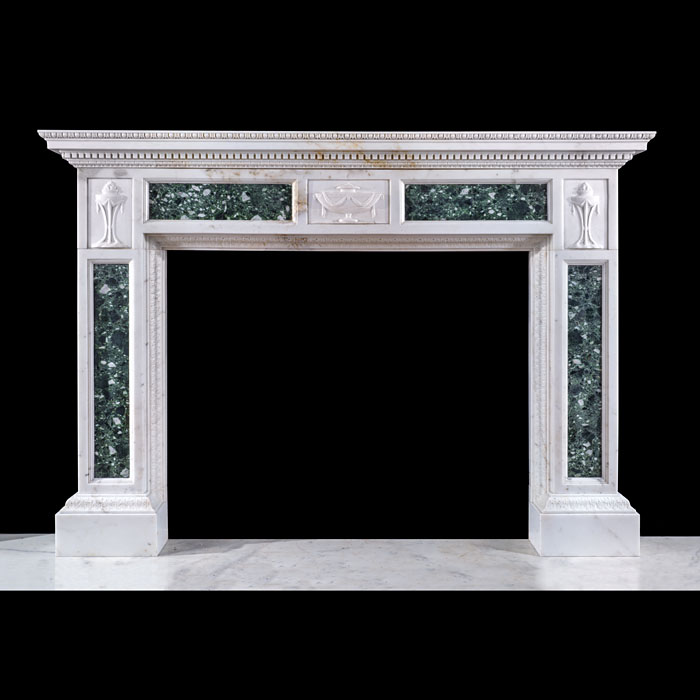
An exceptionally rare chimneypiece by Robert Adam.
This chimneypiece is an exciting new discovery. Commissioned by General John Burgoyne (1722-1792) for the eating room of his London residence at 10 Hertford St, Mayfair, it was designed by Robert Adam to embrace the Italian Neoclassicism both patron and architect had enjoyed during their time in Italy.
Burgoyne was a professional soldier, and despite being the son of a Baronet he relied on his military income. In 1743, he eloped with Lady Charlotte Stanley and as a result the pair were denied Lady Charlotte’s dowry, forcing them into and an extended trip to Europe to avoid their creditors in 1749.
It was in Aix-en-Provence that the couple struck up a friendship with the young architect, meeting him again in Florence, and visiting him at his apartments in Rome on several occasions. When their fortune had been restored by the generosity of Lady Charlotte’s father, the couple sought an architect to design the interiors for their new home they had leased on Hertford St. Naturally they engaged their friend Robert Adam, who set about designing the interior mouldings, chimneypieces and furniture for the fourteen rooms. Many of the drawings for these interiors survive in the Sir John Soane archive. At this time, Robert Adam was still Architect of the King’s Works, so Burgoyne had employed the very best architect to finish his new home.
Adam’s grand tour similarly started in France, and continued to Florence and Rome, where he met Giovanni Battista Piranesi, an established architect and printmaker known for his fantastical drawings of ancient ruins and precise interpretation of classicism. The pair enjoyed many drawing excursions together, the product of which became an essential marketing tool for the young architect, who sent these sketches back to England to win business, which it did. Within five years of his return to England, Adam was swamped with work.
What makes this chimneypiece so interesting is undoubtedly its association and stylistic similarities with Piranesi, with whom Adam shared a close friendship. We know for certain that this chimneypiece was designed after Adam’s time in Rome, having been commissioned by Burgoynes in 1769. Interestingly, this is the date of publication for Piranesi’s volume of chimneypiece designs, his Diverse Manière Cammini, which comprises 62 fanciful designs designed to be a complete departure from the Italian neoclassicism which emerged in the Renaissance.
This chimneypiece is not only Italianate in design, it is also constructed very much in the Italian manner, utilising 4 large blocks of marble which were hewn into shape from the whole. In contrast, English chimneypiece construction of this period was more aligned with cabinetmaking, using sheets of marble that were joined together. Here, the tablet and endblocks have been let in, and it is perhaps the case that the chimneypiece was made in Italy under instruction from Robert Adam and was finished in England. The carving is exquisite and bears many similarities to a design Piranesi published in his volume. Simple in form, the shelf features a small egg and dart moulding above crisply carved dentil and leaf and dart mouldings. This is supported by a generous frieze, inset with panels of verde antico marble centred by an urnular tablet, and flanked by endblocks carved with candlestands, which also bear resemblance to Piranesi’s design. The verde antico is also inset on the jambs, and the opening is framed with more exquisitely carved leaf and dart, which continues around the footblocks. This chimneypiece is very substantial in size, and is a truly innovative piece of 18th century design, and a striking departure from other English chimneypieces of the same date.
English, c.1769.
Full provenance on request.
View our section showing the full range of our neo-classical chimneypieces
|
Width |
Height |
Depth |
| External |
79 1⁄4"
201.5 cms |
56 1⁄8"
142.5 cms |
8 7⁄8"
22.5 cms |
| Internal |
50"
127 cms |
40 5⁄8"
103.2 cms |
|
-
 Sold
Sold
Stock: 6627
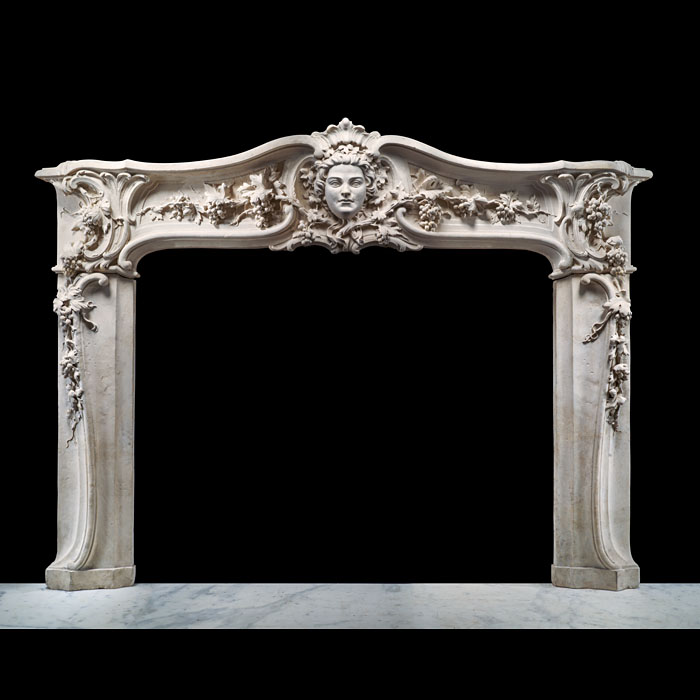
It is hard to overstate the importance of this chimneypiece. Carved in a fine-grained limestone around 1750 by the most successful architect of 18th century Britain, it is a rare relic of a body of work that has otherwise been lost to time. The research undertaken suggests this grand chimneypiece was once in the dining room of 36 Lincoln’s Inn, one of two grand houses designed by the architect on this street. This building was demolished in 1859, whilst number 35 was lost in the blitz.
The design of this chimneypiece would have perfectly suited a dining room, impressive in scale, with Bacchus at the centre and grapevines carved in high relief along the frieze and jambs. In the Survey of London in 1912 there is a record for a remarkably similar stone chimneypiece of this style in the basement of 35 Lincoln’s Inn, having been moved from the principal room when the building was reconfigured for office use. As the properties were designed as a pair, it is conceivable, and indeed extremely likely that these chimneypieces were too.
Few recognise the name of this great architect despite the fame and wealth he enjoyed during his lifetime - which surpassed that of his peers we so revere today - figures such as Robert Adam, Sir John Soane and William Kent. With the recent scholarship of architectural historians such as Marcus Binney and Christopher Hussey, Robert Taylor and his work has come into focus once more.
Robert Taylor came to architecture from sculpture. This is evident in his work which was so full of life, and a departure from the stark Palladianism which had gripped Britain in the decades before him. An apprentice of Henry Cheere, who held positions such as the Sculptor of Oxford University and Carver for Westminster Abbey during his long career, his understanding of the Rococo would have been learnt from his master, who had embraced the lightness of the style in a number of funerary monuments and indeed chimneypieces commissioned across England.
Taylor was born into his career, as his father was a stonemason who sponsored his son from a young age. His father funded his apprenticeship to Cheere, and also a trip to Rome, but sadly died soon after, forcing his son to return to London, penniless and seeking a career in stone carving. He did just that, and flourished within not only monumental masonry, but as an architect, working on projects such as the Bank of England and stately homes; he was also appointed architect of the King’s Works in 1769. His style developed from his sculpture into architecture, where he introduced a light, organic quality that he had learnt from Cheere during his education in stone.
The English Rococo style was merely a fleeting moment in Georgian England, perhaps due to the great marketing prowess of the Adam Brothers, who built and filled homes of varying status with their interpretation of neo-classicism. This popular new style proliferated through their design treatise, entitled, ‘Works in Architecture’, published over three volumes, cementing the brothers as the tastemakers of Georgian Britain. Taylor published no such volume, and instead sought commissions that were financially rewarding. This was starkly opposed to the Adam brother’s enthusiasm for grand redevelopment projects and large bank loans, which would ultimately lead to their demise.
Ultimately, Taylor’s practice was so successful that on his death, he left an estate of £180,000 — in contrast, William Kent left £10,000, James Gibbs £25,000, and Christopher Wren £50,000. Sadly, much of his architectural output is now lost, destroyed as a result of WWII bombings, demolition and redevelopment. As a result, his name faded into relative obscurity in the years following his death, and his legacy and reputation has only come to light in recent years.
If you wish to read more about this spectacular chimneypiece and its designer, please send us an email and we would be delighted to send you the relevant publication.
View our section showing full range of neo-classical chimneypieces
|
Width |
Height |
Depth |
| External |
88 5⁄8"
225 cms |
67 11⁄16"
172 cms |
11 13⁄16"
30 cms |
| Internal |
61 5⁄8"
156.5 cms |
50"
127 cms |
|
-
 Sold
Sold
Stock: 16739
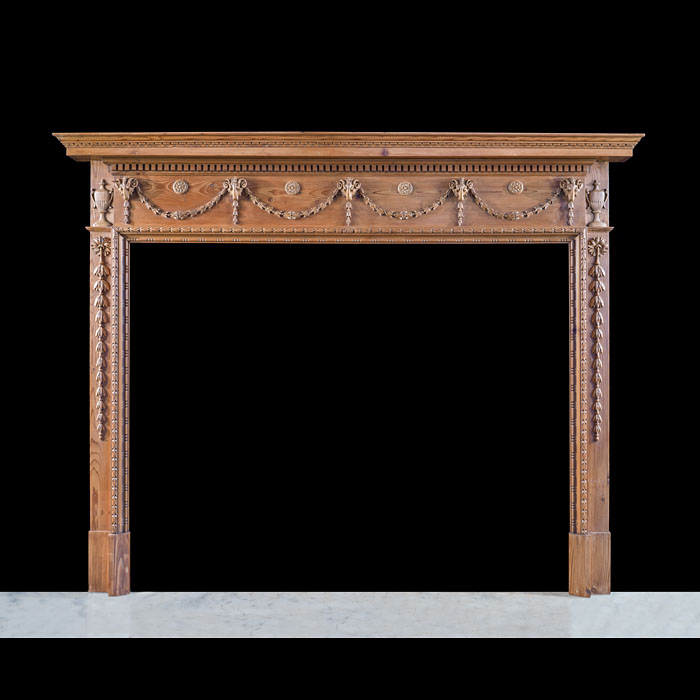
A very fine Adam Revival pine chimneypiece from the Edwardian period. The shelf, with its dentil undershelf is mounted over the beautifully carved frieze, studded with ram's heads hung with garlands of bellflowers. The slender jambs are carved with urns and more bellflowers. The opening is framed by a simple bead and reel moulding. This fireplace would accommodate a set of marble slips very nicely.
English, c.1910.
View our section showing full range of neo-classical chimneypieces
|
Width |
Height |
Depth |
| External |
65 1⁄2"
166.3 cms |
53 1⁄8"
135 cms |
5 3⁄8"
13.7 cms |
| Internal |
49 7⁄8"
126.7 cms |
40 7⁄8"
104 cms |
|
-
Stock: 16273
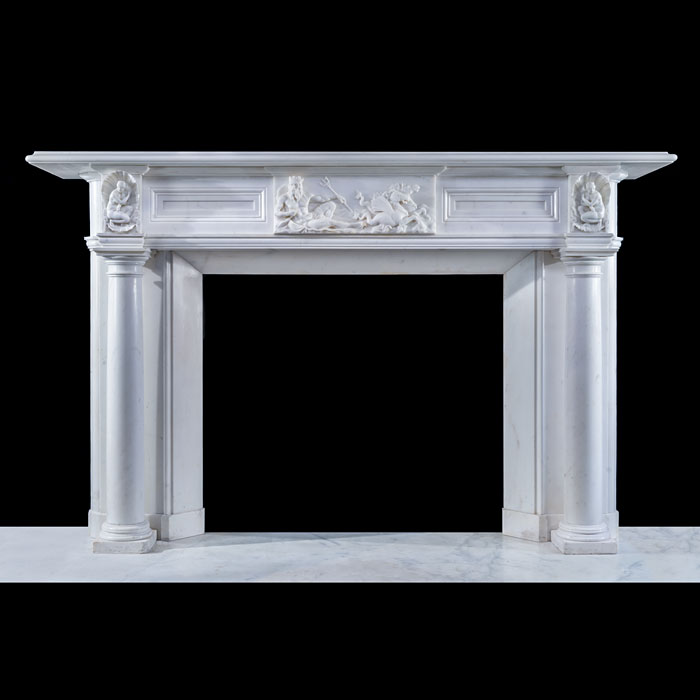
A rare Irish chimneypiece of grand proportions in statuary marble. The generous moulded shelf rests over a wide panelled frieze which is mounted with a tablet of exceptional quality. It depicts a recumbent Poseidon, god of the sea, being drawn on a seashell chariot by hippocampi, all carved in an artful blend of high and low relief. This scene is flanked by the most glorious endblocks, each a crouching Aphrodite, situated within a scallop shell. These crouch above freestanding Doric columns. The strikingly simple elegance of the chimneypiece is a perfect foil for the beautifully carved tablet and spectacular endblocks.
Irish, c.1820.
Provenance:
Raheen House, Raheen, Clonmel, Co. Tipperary, Southern Ireland.
By repute, the chimneypiece was installed at Raheen House by the then owners of the house, the Burke family, circa 1889, when they apparently acquired it in lieu of a part payment for a warehouse. This commercial building was purchased by the Loreto Convent of Clonmel to be used as a religious school when their own school was damaged by fire.
View our section showing the full range of our neo-classical chimneypieces
|
Width |
Height |
Depth |
| External |
83 7⁄8"
213 cms |
54 11⁄16"
139 cms |
18 1⁄8"
46 cms |
| Internal |
43 1⁄4"
110 cms |
38 5⁄8"
98 cms |
|
-
Stock: 16759
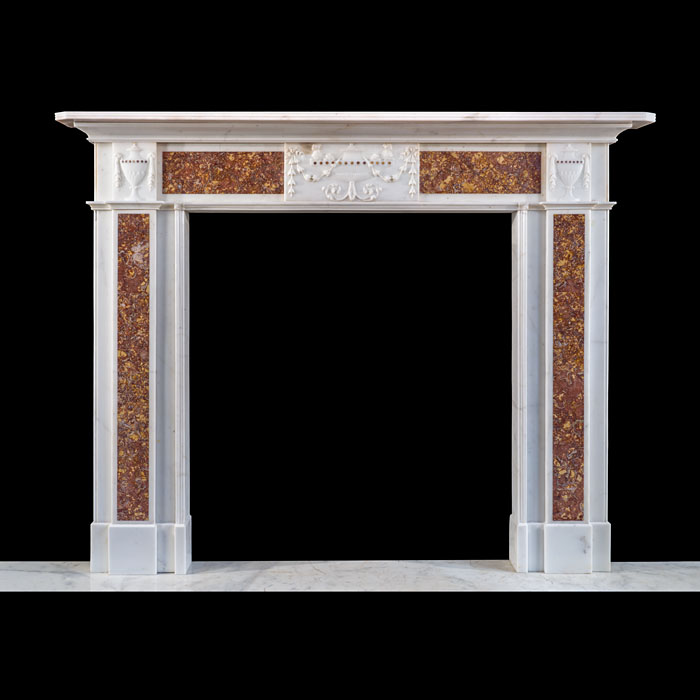
A fine neoclassical chimneypiece of excellent proportions, carved from a pure white statuary marble and inlaid with panels of warm Spanish brocatelle marble. The reeded shelf rests over frieze of panelled brocatelle, set with a finely carved neoclassical tablet very much in the Adam style, carved with an urn and opposing sphynxes, and hung with bellflowers. The endblocks are carved with more slender covered urns and rest above the wide jambs, also set with brocatelle and enclosing the reeded slip bordering the opening. A very elegant late Georgian piece, anticipating the simple elegance of the Regency period.
English, c. 1800.
Footblock to footblock measurement: 151.2cm,
Largely original, with addition of later undershelf. Tablet has a rust stain, which can be restored if desired.
View our collection of: Antique English Regency chimneypieces inc. George IV fireplace mantels.
|
Width |
Height |
Depth |
| External |
66 3⁄16"
168.2 cms |
52 13⁄16"
134 cms |
8 1⁄2"
21.5 cms |
| Internal |
38"
96.5 cms |
42 1⁄8"
107 cms |
|
| Foot to Foot |
59 1⁄2"
151.2 cms |
|
|
Listed Price: £25,000 (+VAT where applicable)
More info?

-
Stock: 9240
A grand and impressive Palladian style chimneypiece in finely carved Portland Stone. The wide shelf carved in high relief with an undershelf of repeating acanthus leaf motif, over boldly scaled egg and dart over lambs tongue detail. The main ingrounds carved with continuous guilloche motif. The whole is supported on large, sturdy footblocks.
Provenance: Removed from a building in the City of London.
English, late 19th century.
Link to a section showing full range of similar/related neo-classical chimneypieces
|
Width |
Height |
Depth |
| External |
112 13⁄16"
286.5 cms |
87 5⁄8"
222.5 cms |
17 7⁄8"
45.5 cms |
| Internal |
65 3⁄16"
165.7 cms |
63 11⁄16"
161.7 cms |
|
-
Stock: 15648
An elegant chimneypiece of a good size in a pure white statuary marble with Siena marble ingrounds. The inverse breakfronted shelf rests over a crisply fluted frieze, which is mounted with a tablet, deftly carved with a reclining figure holding a harp. This detail is echoed on the endblocks, which are decorated with a foliate lyre and trumpets. These are mounted over the slender scrolling console jambs.
An interesting chimneypiece, spanning the stylistic gap between the Georgian and Regency periods.
English, c.1810, with restorations.
View our collection of: Antique English Regency chimneypieces inc. George IV fireplace mantels.
|
Width |
Height |
Depth |
| External |
67 3⁄8"
171.3 cms |
52 7⁄8"
134.4 cms |
6 1⁄8"
15.5 cms |
| Internal |
42 7⁄8"
109 cms |
40 11⁄16"
103.5 cms |
|
Listed Price: £18,000 (+VAT where applicable)
More info?
-
 Sold
Sold
Stock: 6596
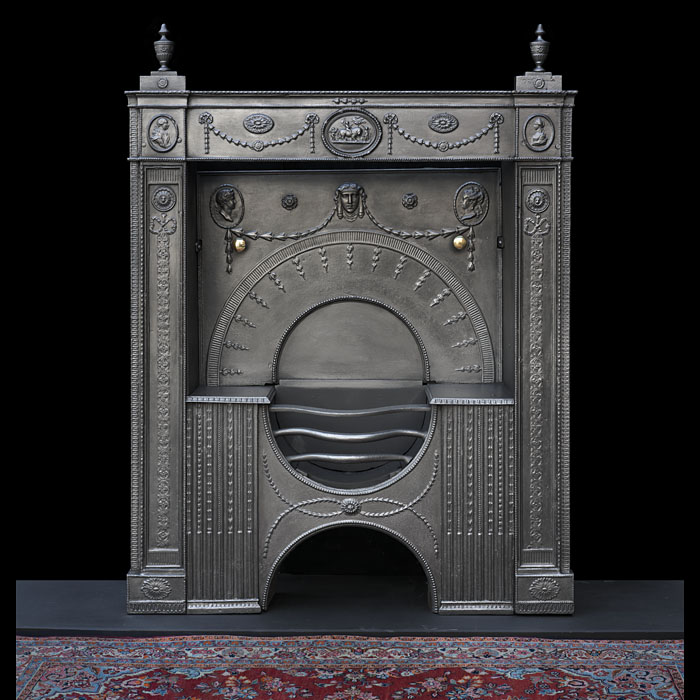
An exceptionally rare and finely cast George III neoclassical cast iron chimneypiece, attributed to Robert Adam. The frieze is delicately decorated with a finely cast central oval cartouche depicting the Triumph of Love, flanked by garlands of bellflowers and floral paterae. The endblocks are decorated with portraits of King George III and Queen Charlotte and are surmounted by a pair of neoclassical urns. These are supported on panelled jambs containing circular lion mask paterae and ribboned floral borders over paterae footblocks.
The fluted integral hob grate with serpentine bars is decorated with bell flowers and a central floral paterae. The handsome back plate with a half round arch, above which is a central mask, strung with garlands of bellflowers, which meet two portraits of the King and Queen again, this time in a distinctly classical guise.
English, circa 1760.
Provenance: Balcares House, from the London residence of the Earl of Crawford.
Awaiting further research.
View our section showing the full range of our neo-classical chimneypieces
|
Width |
Height |
Depth |
| External |
42 1⁄2"
108 cms |
55 1⁄2"
141 cms |
13"
33 cms |
| Internal |
30 11⁄16"
78 cms |
22 3⁄16"
56.5 cms |
|
-
 Sold
Sold
Stock: 8232
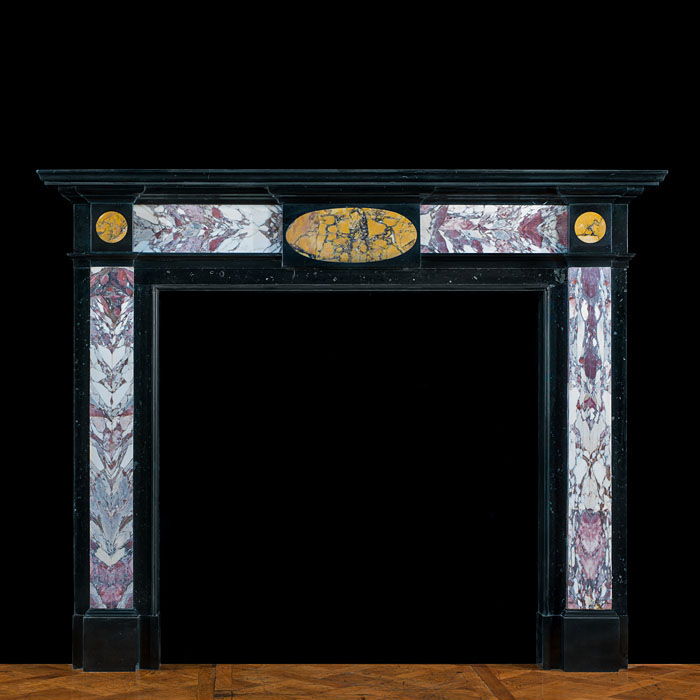
A very smart English Regency specimen marble chimneypiece in Kilkenny Black Fossil Marble inlaid with Breche Violette marble panels which have been cut and opened like a book to reveal symetrical veining. The oval plaque on the frieze and the flanking end blocks are of inlaid Convent Sienna Marble. English, circa 1820.
Link to: Antique English Regency chimneypieces inc. George IV fireplace mantels.
|
Width |
Height |
Depth |
| External |
69"
175.3 cms |
55 11⁄16"
141.6 cms |
6"
15.2 cms |
| Internal |
43"
109.2 cms |
42 1⁄2"
108 cms |
|
-
Stock: 16083
A good George III carved statuary and Siena marble chimneypiece with a games theme! The inverted breakfront shelf sits above a frieze depicting putti playing a game of 'blind man's bluff' within a classical setting. This scene is flanked by endblocks depicting putti playing battledore and shuttlecock, whilst the jambs below show putti skipping over neoclassical vases hung with swags. These sit either side of the generous Siena marble slips.
This is a really unusual chimneypiece with a wonderfully lighthearted subject.
English, c.1790 with later restorations.
View our section showing the full range of our neo-classical chimneypieces
|
Width |
Height |
Depth |
| External |
72"
183 cms |
60 5⁄8"
154 cms |
7 1⁄8"
18 cms |
| Internal |
42 11⁄16"
108.5 cms |
44 3⁄16"
112.2 cms |
|
-
Stock: 13154
A grand and large George III twin columned warm toned pine and gesso Georgian chimneypiece with its original Carrara Marble slips. The fluted and anthemion decorated frieze is centred by a plaque depicting four classical Greek figures around a weeping child. Each pair of slender twin columns on the jambs are separated by tumbling vines beneath end blocks with elaborately styled platters of fruit.
English circa 1770.
Link to a section showing full range of similar/related neo-classical chimneypieces
|
Width |
Height |
Depth |
| External |
77"
195.5 cms |
58"
147.3 cms |
8 1⁄4"
21.2 cms |
| Internal |
41 11⁄16"
106 cms |
40 7⁄8"
104 cms |
|
Listed Price: £12,200 (+VAT where applicable)
More info?
-
Stock: 15958
A fine and grand neoclassical chimneypiece in statuary marble with Siena marble inlay. The boldly carved breakfront shelf sits above a high relief egg and dart undershelf and a finely fluted frieze inlaid with Siena marble. This is mounted with a beautifully carved tablet depicting putti feeding a goat within a pastoral landscape. This symbolises abundance. The solitary putto endblocks rest on three-quarter pilasters with inlaid Siena volutes over plain jambs.
English, c.1760 with nineteenth-century restorations.
View our section showing the full range of our neo-classical chimneypieces
|
Width |
Height |
Depth |
|
72 1⁄2"
184.2 cms |
61 5⁄8"
156.5 cms |
11"
28 cms |
|
43 11⁄16"
111 cms |
40 1⁄2"
102.8 cms |
|
-
 Sold
Sold
Stock: 15984
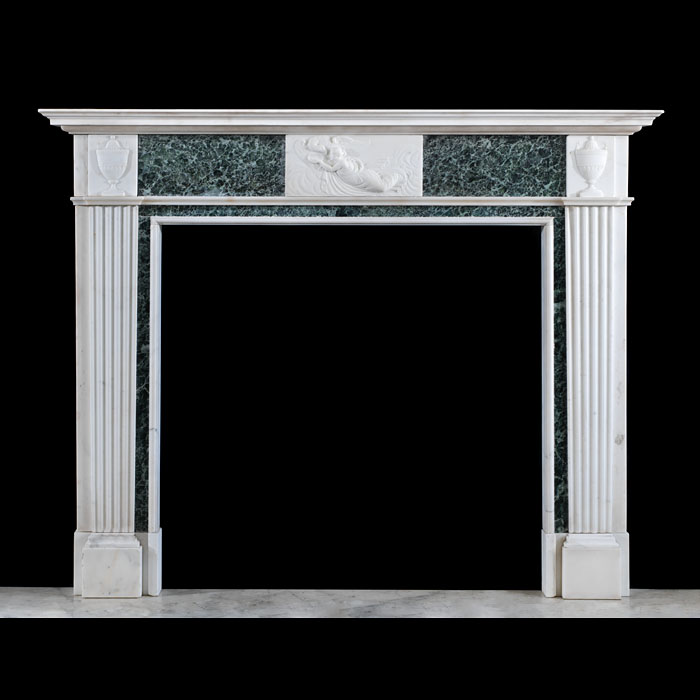
An antique Neo-classical white statuary marble fireplace with Verde Antico ingrounds and frieze panels centred by a carved central tablet depicting Hebe in classical robes feeding Jupiter in the form of an eagle among clouds. This is flanked by a pair of 18th century corner blocks nicely carved with lidded urns.
English, circa 1900 and earlier.
View our section showing full range of neo-classical chimneypieces
|
width |
height |
depth |
|
58 11⁄16"
149.2 cms |
47 3⁄16"
119.8 cms |
6 1⁄2"
16.5 cms |
|
36 13⁄16"
93.5 cms |
36 1⁄8"
91.6 cms |
|
-
Stock: 15844
A fine eighteenth century George III chimneypiece in statuary marble. The solid reverse breakfront shelf sits above a frieze which is delicately carved with a stylised foliate design. This is centred by a tablet depicting a putto imitating Bacchus riding on a goat drawn chariot with two other putti in attendance. The endblocks are carved with urns hung with bellflowers and are supported by carved jambs which depict one putting holding a rake, whilst the opposing holds a scythe above trailing bellflowers.
English, c.1790 with restorations.
Ingrounds are a later replacement, and these can in turn be replaced with another marble.
View our section showing full range of neo-classical chimneypieces
|
Width |
Height |
Depth |
| External |
65 3⁄16"
165.5 cms |
51 13⁄16"
131.5 cms |
8 1⁄2"
21.6 cms |
| Internal |
37 3⁄8"
95 cms |
36 13⁄16"
93.5 cms |
|
-
Stock: 15775
A large eighteenth century English neoclassical chimneypiece of exceptional quality. The moulded reverse breakfront shelf sits above a frieze inlaid with volutes of sarrancolin marble. The central tablet has been deftly carved with a neoclassical urn hanging with bellflowers.The delicately carved endblocks are supported by jambs also inlaid with volutes of soft amber coloured sarrancolin marble. Remarkably, this fireplace has had very few repairs over the centuries, and remains in beautiful, original condition.
English, c.1780.
View our section showing full range of neo-classical chimneypieces
|
Width |
Height |
Depth |
| External |
69 11⁄16"
177.1 cms |
58 7⁄8"
149.6 cms |
7 1⁄2"
19 cms |
| Internal |
44 1⁄4"
112.4 cms |
46 1⁄8"
117 cms |
|
-
 Sold
Sold
Stock: 11067
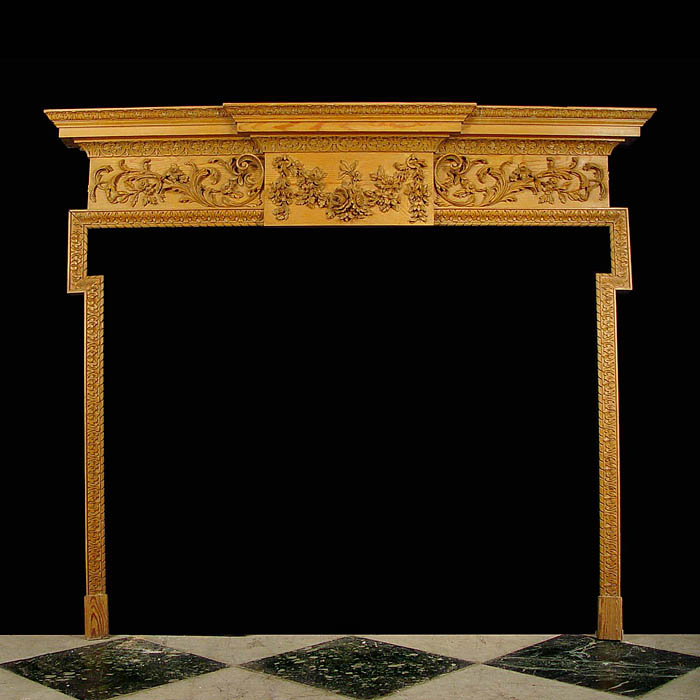
A fine 19th century carved pine chimneypiece in the Georgian manner, with a frieze decorated with finely carved floral garlands and foliate flourishes. Intended to be fitted with marble slips, which we can provide.
English, c. 1880.
|
Width |
Height |
Depth |
| External |
61 11⁄16"
156.8 cms |
52 5⁄8"
133.5 cms |
6 1⁄4"
16 cms |
| Internal |
53 11⁄16"
136.5 cms |
40 11⁄16"
103.4 cms |
|
| Bottom width |
54 1⁄8"
137.5 cms |
|
|
-
Stock: 15438
A late 18th century Statuary and Brocatelle marble chimneypiece, inlaid with a Greek key design on the frieze. The finely carved tablet depicts a goddess, perhaps Persephone, holding a cornucopia brimming with fruit, including a pineapple; something of a luxury in 18th century Britain. Beside her, a putto holds aloft an ear of wheat as he rides a lion pulling the goddess' chariot. In the distance, a small temple sits atop a hill, very much like the temple follies seen in 18th century parkland. Flanking the frieze are two elegantly carved endblocks, depicting a putto holding torches - another symbol of Persephone. These are supported by gently tapered jambs, inlaid with flutes of brocatelle marble and terminating in plain footblocks.
English, Circa 1790 with restorations.
View our section showing full range of neo-classical chimneypieces
|
Width |
Height |
Depth |
| External |
74 13⁄16"
190 cms |
60 13⁄16"
154.5 cms |
8 7⁄8"
22.5 cms |
| Internal |
48 3⁄8"
123 cms |
47"
119.5 cms |
|
-
 Sold
Sold
Stock: 15429
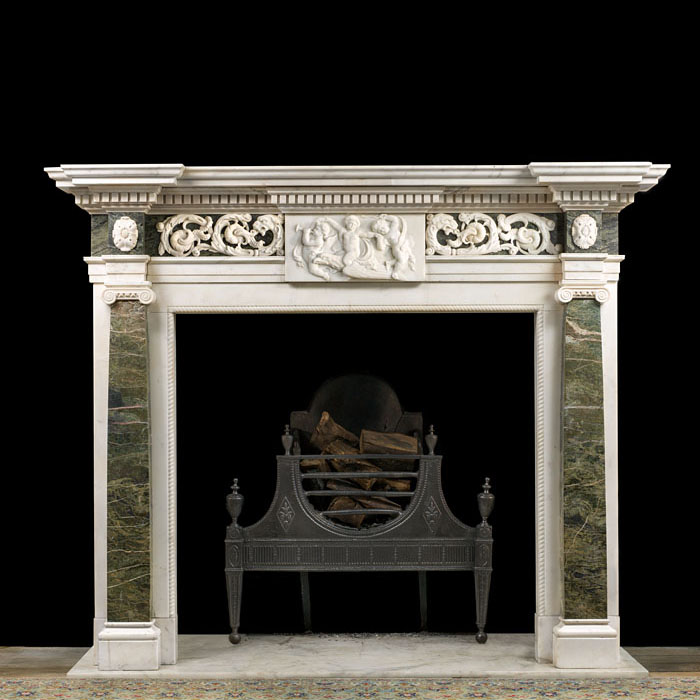
A large and imposing Statuary and Connemara marble Neoclassical style chimneypiece very much in the Palladian manner of Isaac Ware. The wide stepped shelf rests above a band of substantial dentil carving, beneath which lies a Connemara marble frieze centred with a large statuary marble tablet depicting playful cherubs riding an eagle, the tablet is flanked by bold statuary carvings of mythical dragons. The paterae endblocks sit above plain, tapering Connemara columns on the jambs.
English, circa 1890.
Shown here with fire basket SNo 14151 not included.
The Palladian style was named after the Venetian Renaissance architect Andrea Palladio (1508-1580) whose work and ideas were based on the symmetry and perspective of the formal classical temple architecture of the Ancient Greeks and Romans. His work hugely influenced European architecture from the early 17th century to the present day.
View our section showing full range of similar/related neo-classical chimneypieces
|
Width |
Height |
Depth |
| External |
73 1⁄2"
186.6 cms |
58 1⁄4"
148 cms |
12"
30.5 cms |
| Internal |
43 1⁄8"
109.5 cms |
41 11⁄16"
106 cms |
|
-
 Sold
Sold
Stock: 6593
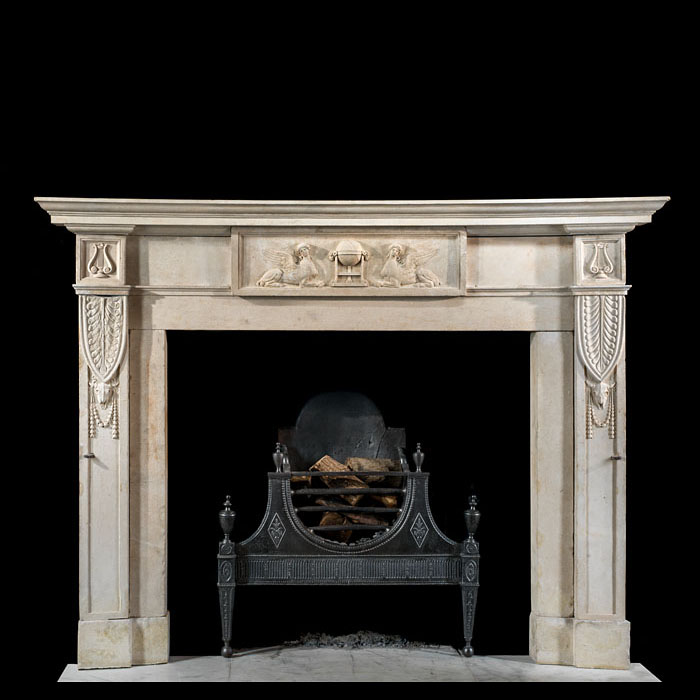
The Dalquharran Castle Chimneypiece.
A very rare, gently concave Portland Stone fireplace designed by Robert Adam and carved by the renowned Dutch stonemason Pieter Mathias van Gelder.
A moulded shelf rests above a simple frieze centred by a panel carved in relief with a floor standing globe flanked by opposing sphinxes. The endblocks, with carved lyres and husk swags, sit above fern frond corbels terminating in festooned bucrane on fielded panel jambs raised on stepped footblocks.
English, circa 1790.
Dalquharran Castle in Ayrshire, Scotland, is regarded as one of the finest examples of Robert Adam’s Castle Style. His castles were unique in the respect that whilst the outside embodied the robustness associated with a castle, the inside was the embodiment of his restrained and delicate classical style. Dalquharran Castle was created for Thomas Kennedy of Dunure but is sadly now a ruin after the roof was removed in 1967 to avoid paying rates.
The chimneypiece was originally installed in the round tower library of the Castle and epitomised Adam's classical elegance. The last image below shows it in situ in the ruins of the library. It is exceptionally rare to find such a piece and made even more remarkable as it survived virtually undamaged. There is a similarly fine chimneypiece at Seton Castle, Adam’s final project in Scotland.
Link to a section showing full range of similar/related neo-classical chimneypieces
|
Width |
Height |
Depth |
| External |
78"
198.2 cms |
58 13⁄16"
149.3 cms |
12 5⁄8"
32 cms |
| Internal |
47 13⁄16"
121.5 cms |
42 1⁄2"
108 cms |
|
-
Stock: 7360
A large and very finely made replica Chimneypiece in the Italian Neo Classical manner in Statuary Marble inlaid with Cippolino, Portoro, Sienna, Breccia Colorato and Aegean Bordeaux specimen marbles. The egg and dart moulding beneath a breakfront shelf is above a frieze centred by a carved Statuary marble cartouche inlaid with Cippolino marble flanked by oval Portoro marble endblocks.
Italian late 20th century.
Link to a section showing full range of similar/related neo-classical chimneypieces
|
Width |
Height |
Depth |
| External |
98 1⁄2"
250.2 cms |
76"
193 cms |
11 11⁄16"
29.8 cms |
| Internal |
61"
154.9 cms |
50"
127 cms |
|
-
Stock: 11376
A fine, late 18th century antique fireplace surround in Statuary marble with Spanish Brocatelle marble fluting and ingrounds. The breakfront shelf rests on a frieze with inlaid Brocatelle marble fluting, which is interspersed by delicately carved rosette paterae. The frieze is flanked by endblocks carved with pillar vases and trailing leaves above tapering fluted jambs raised on stepped footblocks.
English circa 1780.
Known provenance.
Link to a section showing full range of similar/related neo-classical chimneypieces
|
Width |
Height |
Depth |
| External |
69 1⁄4"
176 cms |
58 11⁄16"
149 cms |
6"
15.3 cms |
| Internal |
41 1⁄4"
104.8 cms |
42 1⁄8"
107 cms |
|
-
Stock: 8445
A George II antique pine chimneypiece with leaf carved moulding & vines, with bunches of grapes on the frieze.
English, Circa 1760.
Link to a section showing full range of similar/related neo-classical chimneypieces
|
Width |
Height |
Depth |
| External |
61 13⁄16"
157 cms |
61 3⁄8"
156 cms |
6 11⁄16"
17 cms |
| Internal |
44 7⁄8"
114 cms |
46 1⁄2"
118 cms |
|
Listed Price: £4,300 (+VAT where applicable)
More info?
-
Stock: 14950
An early 20th century Neoclassical style Statuary and Sienna Marble chimneypiece. The Sienna panelled frieze beneath the stepped moulded shelf is centred by a carved Statuary Marble plaque depicting Venus and Cupid. Finely carved floral paterae adorn the endblocks above tapering, panelled Sienna columns on the jambs. English, circa 1930.
Link to a section showing full range of similar/related neo-classical chimneypieces
|
Width |
Height |
Depth |
| External |
61 1⁄4"
155.7 cms |
51 1⁄2"
130.8 cms |
8 1⁄2"
21.6 cms |
| Internal |
36 1⁄8"
91.8 cms |
40 3⁄16"
102 cms |
|
Listed Price: £8,200 (+VAT where applicable)
More info?
-
Stock: 10093
A substantial and profusely carved pine Fireplace Surround in the Neo Classical manner. The central plaque floral swar is finely carved in high relief, the endblocks with stylised foliate paterae and with acanthus corbels and descending festoons on the jambs.
English 19th century.
Link to a section showing full range of similar/related neo-classical chimneypieces
|
Width |
Height |
Depth |
| External |
75 3⁄16"
191 cms |
52 3⁄8"
133 cms |
11"
28 cms |
| Internal |
42 1⁄8"
107 cms |
37 5⁄8"
95.5 cms |
|
Listed Price: £8,500 (+VAT where applicable)
More info?
-
Stock: 7602
An attractive and delicately carved white Carrara marble antique fireplace surround in the Italian Imperio manner with inset Brescia Violette panels. The frieze with a central crown of laurel leaves flanked by a pair of Brescia Violette panels, echoed on the jambs, is flanked by floral paterae on the endblocks set above twin trophy panels on the jambs signifying Victory. Italian, circa 1800 (with restoration).
Shown here with andirons SNo 12527 not included.
Link to a section showing full range of similar/related neo-classical chimneypieces
|
Width |
Height |
Depth |
| External |
60 1⁄2"
153.7 cms |
46 1⁄4"
117.5 cms |
12"
30.5 cms |
| Internal |
45 1⁄2"
115.6 cms |
37"
94 cms |
|
Listed Price: £9,500 (+VAT where applicable)
More info?
-
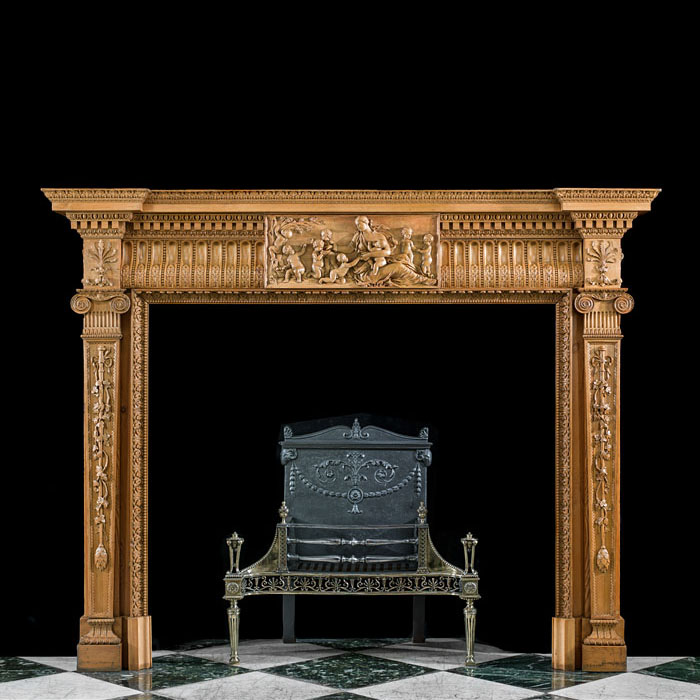 Sold
Sold
Stock: 14246
A very finely carved Neoclassical style antique pine chimneypiece. The shelf, with floral under carving, egg and dart and dentl borders, rests above a delicate stop fluted frieze centred by a large central plaque depicting an allegorical scene of a seated goddess, possibly Eileithyia the Greek Goddess of Childbirth, surrounded by children gathering fruits. The foliate detailed endblocks rest on Ionic capitals above tapering panels with vine entwined rods on the jambs. The opening with an embellished floral edging.
English, early to mid 19th century.
Shown here with firegrate SNo 14748 not included.
Link to a section showing full range of similar/related neo-classical chimneypieces
|
Width |
Height |
Depth |
| External |
71 1⁄8"
180.5 cms |
56 1⁄2"
143.5 cms |
6 11⁄16"
17 cms |
| Internal |
48"
122 cms |
43 3⁄16"
109.8 cms |
|
| Bottom width |
63 7⁄8"
162.3 cms |
|
|
-
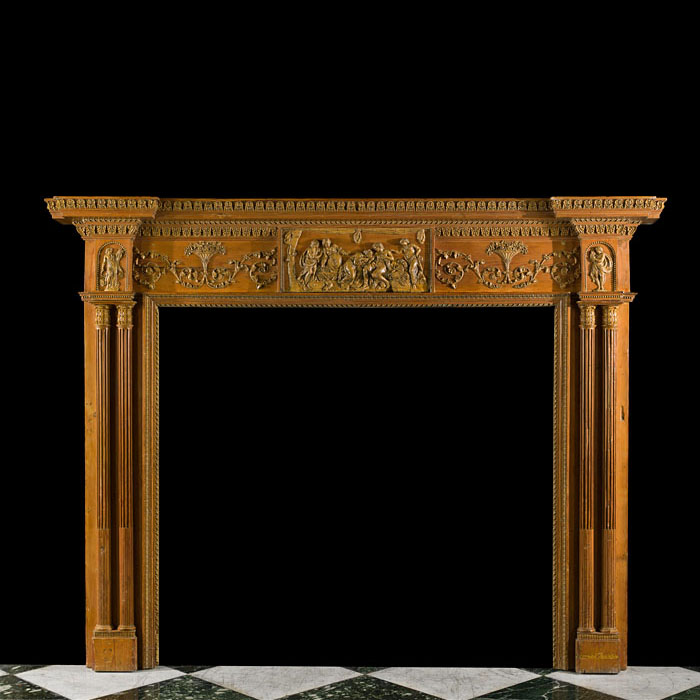 Sold
Sold
Stock: 13632
A beautifully carved, highly ornate late 18th century pine and applied gesso twin columned antique chimneypiece. The under shelf, embellished with delicate acanthus leaf detail also seen throughout the fireplace, is set above a frieze centred with a gesso panel of classical figures in a rural setting. The endblocks, with further gesso figures representing the harvest, rest above the two sets of slender twin columns fronting the jambs. Provenance: Purportedly from Thame Park an early Georgian House in Oxfordshire.
English circa 1780.
Please note: There is some cracking to the gesso commensurate with age.
Link to a section showing full range of similar/related neo-classical chimneypieces
|
Width |
Height |
Depth |
| External |
76 13⁄16"
195 cms |
58 1⁄2"
148.5 cms |
7 1⁄8"
18 cms |
| Internal |
49 3⁄8"
125.5 cms |
45 11⁄16"
116 cms |
|
| Bottom width |
66 1⁄2"
169 cms |
|
|
-
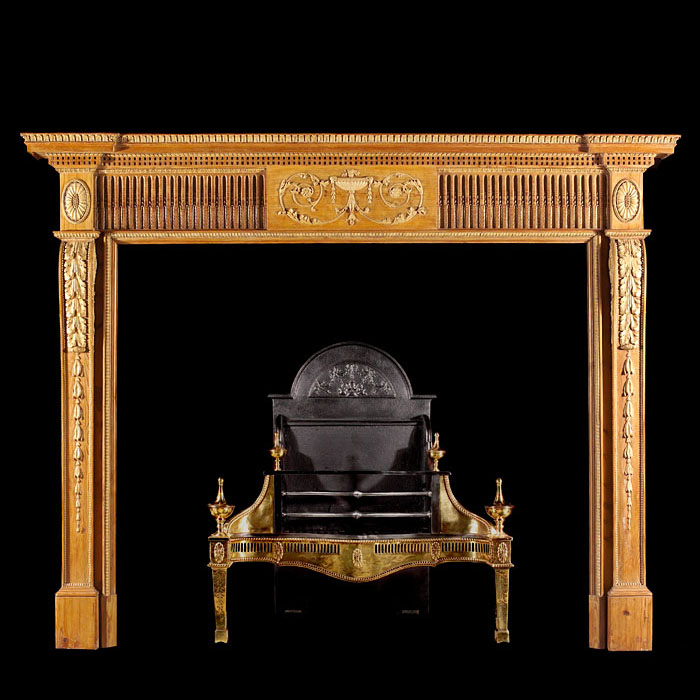 Sold
Sold
Stock: 8395
A large elegant George III style antique fireplace surround carved in pine & gesso in the style of Adam. The central plaque decorated with Arabesque floral scrolls and urns, set on a stop fluted frieze flanked by oval floral paterae on the endblocks above scrolled jambs with applied acanthus and descending bellflower decoration and with abundant husk detail edging throughout. English, mid to late 19th century.
Shown here with fire grate SNo 8260 now sold.
Link to a section showing full range of similar/related neo-classical chimneypieces
|
Width |
Height |
Depth |
| External |
77 1⁄2"
196.8 cms |
61 1⁄2"
156.2 cms |
6 1⁄4"
16 cms |
| Internal |
56 11⁄16"
144.1 cms |
48 11⁄16"
123.8 cms |
|
-
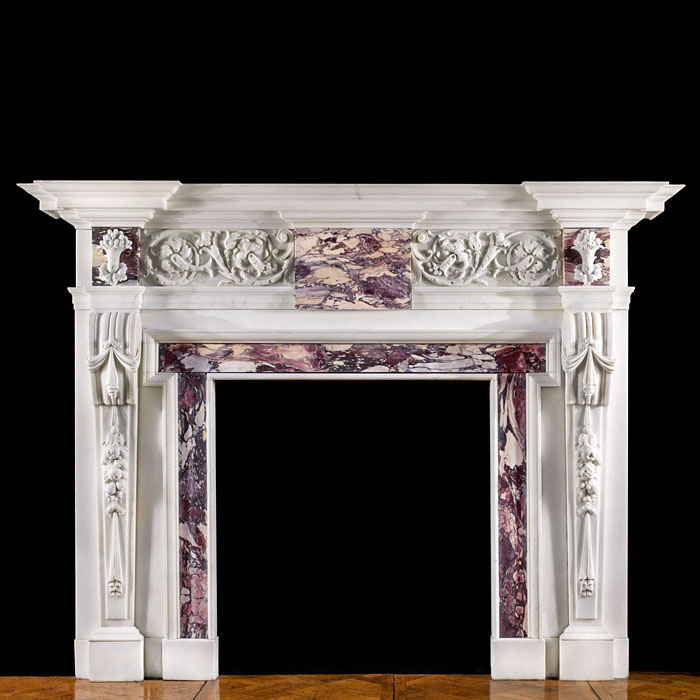
Stock: 10203
A large and fine antique Palladian style chimneypiece in the manner of William Kent (1685-1748). Carved in pure white Statuary Marble and with Breche Violette, endblocks and ingrounds, it has a prominent corniced shelf set over a beautifully scrolled foliate carved frieze, centred by a simple Breche Violette plaque, flanked by foliate endblocks above bold tapering volute jambs, topped by ribbon tied scrolls, resting on plain large footblocks.
English, mid 19th century with later restoration.
Notes: This chimneypiece, made in the 19th Century, bears a striking resemblance to the chimneypiece in the Red Dining Room at Raynham Hall in Norfolk, designed by Inigo Jones in the late 17th Century. The chimneypiece was probably designed by William Kent as the Hall was refashioned by him in 1731 in collaboration with the Master Sculptor & Carver James Richards (1718-1759) who is credited with the carving of the chimneypiece.
Link to a section showing full range of similar/related neo-classical chimneypieces
|
Width |
Height |
Depth |
| External |
97 1⁄2"
247.7 cms |
73 1⁄8"
185.7 cms |
14 3⁄16"
36 cms |
| Internal |
42 1⁄8"
107 cms |
44 11⁄16"
113.5 cms |
|
-
Stock: 12127
A late Georgian neoclassical fireplace surround in the manner of Robert Adam carved in white Statuary marble with yellow Sienna marble inlay. The wide breakfront shelf set over the fluted frieze centred by a large tablet also of purple veined yellow Sienna marble flanked by circular fluted paterae endblocks above fluted jambs.
English, late 18th century with restorations.
|
Width |
Height |
Depth |
| External |
82 1⁄4"
209 cms |
59 1⁄8"
150 cms |
8 1⁄4"
21 cms |
| Internal |
48 3⁄8"
123 cms |
42 11⁄16"
108.5 cms |
|
-
 Sold
Sold
Stock: 13512
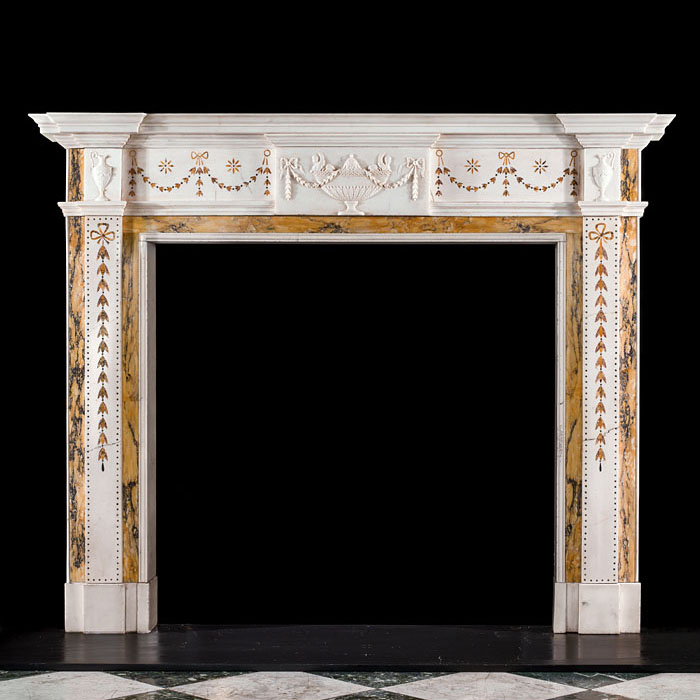
An elegant 20th century Georgian style chimneypiece in Statuary and inlaid Sienna
and Brocatelle marble.The frieze beneath the breakfront shelf embellished
with inlaid sienna festoons and centred by a tablet of a lidded urn surmounted by
a pair of seated sphinx draped with further festoons. The endblocks with tall vases
above descending inlaid sienna bellflowers on the jambs.
English mid 20th century.
Notes: There is an almost identical fireplace in the Library of Shropham Hall, Norfolk, England please see the image below.
Link to a section showing full range of similar/related neo-classical chimneypieces
|
Width |
Height |
Depth |
| External |
74 13⁄16"
190 cms |
60 5⁄8"
154 cms |
8 1⁄4"
21 cms |
| Internal |
48 13⁄16"
124 cms |
46 1⁄2"
118 cms |
|
-
Stock: 11772
A splendid 20th century fossil stone and marble chimneypiece in the Palladian manner. Removed from the Banqueting Hall of The Worshipful Company of Leatherers, an ancient Guild institution in the City of London. The massive white Statuary Marble shelf is supported on a fossil stone frieze centred by a plaque of Verdi Tinos green marble and is flanked by scrolled stone and green marble brackets, over a substantial lower frieze supported on either side by large scrolled consoles. The wide low opening has Statuary Marble ingrounds behind which are a pair of concave Verdi Marble inserts.
English 1950.
Link to a section showing full range of similar/related neo-classical chimneypieces
|
Width |
Height |
Depth |
| External |
95 1⁄4"
242 cms |
66 1⁄4"
168.4 cms |
14 13⁄16"
37.6 cms |
| Internal |
28 11⁄16"
73 cms |
39 1⁄8"
99.3 cms |
|
-
 Sold
Sold
Stock: 12713
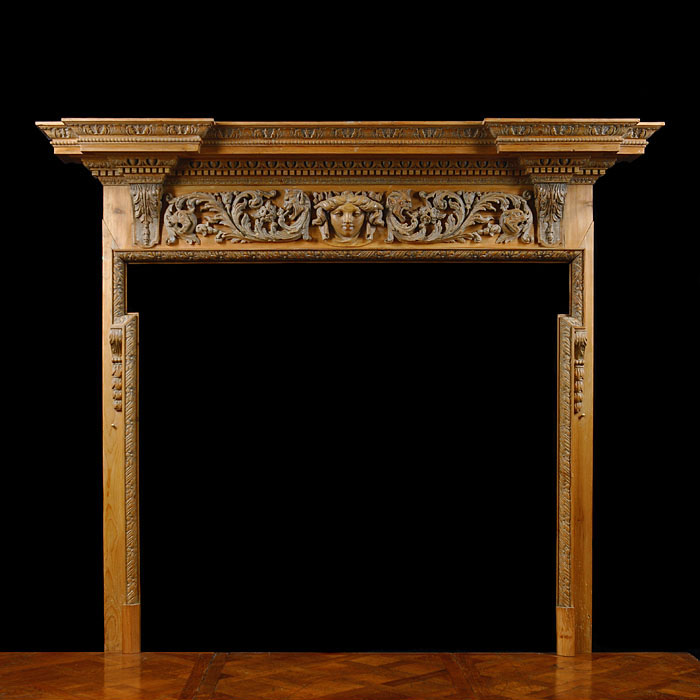
A tall carved pine chimneypiece in the style of William Kent, with a prominent shelf above a frieze profusely carved with scrolling acanthus centred by a female mask. Late 19th century.
Link to a section showing full range of similar/related neo-classical chimneypieces
|
Width |
Height |
Depth |
| External |
73 3⁄8"
186.5 cms |
63 3⁄8"
161 cms |
9 3⁄8"
24 cms |
| Internal |
53 1⁄8"
135 cms |
47 3⁄16"
120 cms |
|
| Bottom width |
59 3⁄8"
151 cms |
|
|
-
Stock: 13386
A very smart late 18th century Statuary and Spanish Brocatelle inlaid marble chimneypiece, the central tablet carved with exquisite crossed leaf fronds and classical urn to the highest quality. The end blocks carved with rosettes common to the period with unusual extra carved oval paterae below.
English, circa 1780 with later restoration.
Link to a section showing full range of similar/related neo-classical chimneypieces
|
Width |
Height |
Depth |
| External |
72 3⁄8"
184 cms |
57 1⁄2"
146 cms |
7 7⁄8"
20 cms |
| Internal |
47 5⁄8"
121 cms |
44 1⁄2"
113 cms |
|
Listed Price: £24,000 (+VAT where applicable)
More info?
Georgian and Neoclassical fireplaces
Our collection of antique Neoclassical and Georgian fireplaces, chimneypieces and mantels comprises an impressive range in marble, wood and occasionally stone. Whether you wish to complement an existing Georgian or Neoclassical interior or add a touch of period style to a modern room, our Georgian and Neoclassical fireplaces are a great way to make a statement.
The Georgian Era
The Georgian era was a fascinating moment in British Art, Architecture, Design and Culture. This period saw the foundation of the Royal Academy of Art and the British Museum, and nurtured some of the finest architects, Robert Adam, John Nash and John Soane. The Georgian monarchy was a Hanoverian one; founded when the protestant George I ascended to the throne following the death of Queen Anne, his cousin. This Hanoverian monarchy ruled at a time of enormous colonial expansion, economic instability and even saw the birth of the Industrial Revolution. Despite the political and social unrest, the royal family were voracious patrons of the arts, and can be credited with nurturing some of the finest design talent of the time, including the revered architect and designer, Robert Adam.
Period Design Features
There was such a broadening and oscillation in artistic style during this period that it is perhaps more accurate to speak of “Georgian styles.” Palladianism, Neoclassicism and the English Rococo all thrived during the eighteenth-century. The overriding sense was a withdrawal from the heavy opulence of the Baroque style. Classical restraint was certainly favoured; symmetry, proportion and elegance were esteemed characteristics of the period. This was in part due to the popularity of the Grand Tour which highlighted some of the greatest sights of antiquity, and provided invaluable inspiration for both the patrons and designers of the 18th century.
Georgian Fireplaces
The Georgian fireplace embodied the favoured architectural characteristics of the period. Classical proportion and features evocative of Greek and Roman architecture were employed to create a grand and elegant focal point in the Georgian home. The Georgian period is often applauded for its development of domestic architecture also; vast swathes in cities and towns were being redeveloped with elegant terraces and villas, each with their own chimneypieces.
A revolution in Georgian fireplace design
Robert Adam was a seminal figure of the 18th century, and it is perhaps his designs for chimneypieces which are most well-known. Adam had studied in Rome and when he returned to Britain in 1758, opened up an architectural practice with his brother James, becoming the leading figure of the classical revival. The firm’s movement away from the rigid Palladianism of the late 17th century led to a lighter, more whimsical classical style. Their firm was not limited to architecture alone; it produced finished interiors using furniture and fittings of their design. As leading architects to Britain’s aristocracy and royalty, they also sought to show that good, harmonious design had a wider civic purpose. The Adam brothers sought democratise taste with a number of ambitious civic projects.
Adam style fireplaces
Adam fireplaces are instantly recognised by their crisp classical motifs carved in low relief in the form of central tablets and endblocks, and pilastered or columned jambs. Their elegance, designed to complement the finest architecture, is unquestionable
The firm also pioneered a pine and composition chimneypiece which is now an iconic part of 18th century design. This composition was made from a secret recipe and could be applied to wooden frames and treated with a number of finishes, such as gilt, paint, and faux marble. It meant that decorative chimneypieces could be manufactured far more quickly than the traditional limewood or marble chimneypieces, allowing the firm to keep pace with the rapid rate of house construction. They were also more affordable, and allowed more modest homes to enjoy the classical styles, which had been before, the preserve of the elite.
The Neoclassical
The neoclassicism typified by Adam style fireplaces evolved as a response to the flamboyant and opulent designs of both the Rococo and Baroque periods. Use of classical motifs was also intrinsically linked to the ideals of the Enlightenment, as classical design conveyed ideas of knowledge and truth. The style was born in Rome in the mid-18th Century after the rediscovery of Pompeii and Herculaneum, and was circulated throughout Europe by a generation of wealthy Grand Tourists and artists, who returned from their Grand Tours in Italy with freshly discovered Greco-Roman ideals.
Neoclassicism favoured a more formal, dignified approach that respected order and decorum, and established rules that became a distinct movement in the decorative and visual arts, literature, theatre, music and architecture throughout northern Europe from the mid-18th to the end of the 19th centuries. It still endures as one of the most popular architectural styles today.
Related periods
If you are drawn to later, more ornate styles, our Victorian fireplace collection is a natural next step from the Georgian period.