Georgian & Neo-Classical Fireplaces - Westland London Antiques
Neoclassical & Georgian, including Adam and Palladian, English, Scottish, Irish & Italian antique fireplaces, mantels and chimneypieces in marble, stone and wood.
-
 Sold
Sold
Stock: 12738
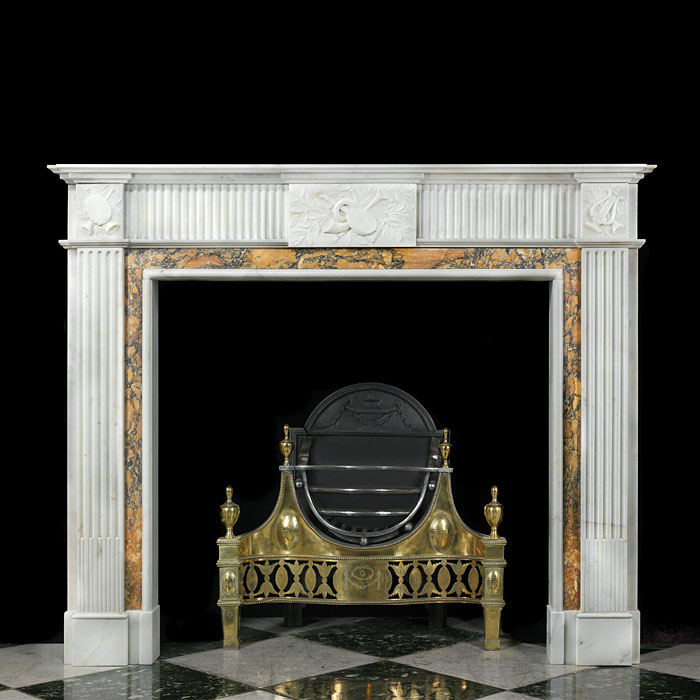
A Georgian style white statuary marble chimneypiece with Giallao di Sienna yellow marble detail, the fluted frieze with a carved central tablet depicting musical instruments the lute and trumpet echoed on the end blocks set above stop fluted pilaster jambs.
English circa 1880.
Link to a section showing full range of similar/related neo-classical chimneypieces
|
Width |
Height |
Depth |
| External |
57"
144.7 cms |
47"
119.5 cms |
6 1⁄8"
15.5 cms |
| Internal |
37 7⁄8"
96.3 cms |
36 1⁄4"
92.3 cms |
|
-
Stock: 8259
Aesop's Fables "The Fox, Stork and Pitcher"
An elegant George III style antique mantle finely carved in white Statuary marble with Sienna marble side panels & ingrounds and Sienna fluted frieze panels. The central plaque with Aesop's fable,"The Fox, the Stork and the Water Pitcher ", these have been recently carved, over fluted jambs.
English, circa 1900 and later.
Link to a section showing full range of similar/related neo-classical chimneypieces
|
Width |
Height |
|
| External |
61"
154.9 cms |
51"
129.5 cms |
|
| Internal |
39"
99.1 cms |
39"
99.1 cms |
|
Listed Price: £24,000 (+VAT where applicable)
More info?

-
Stock: 11466
A large period late Georgian pine Fireplace Surround well carved with egg and dart under the plain moulded shelf and around the opening. The frieze centred by a tablet carved with a ribboned fruit swag. Shown fitted with large marble footblocks and grey veined and figured marble ingrounds.
English 1880s.
Link to a section showing full range of similar/related neo-classical chimneypieces
|
Width |
Height |
Depth |
| External |
81 7⁄8"
208 cms |
63 3⁄8"
161 cms |
8 11⁄16"
22 cms |
| Internal |
66 7⁄8"
170 cms |
50"
127 cms |
|
Listed Price: £8,500 Excluding marble ingrounds.(+VAT where applicable)
More info?
-
Stock: 12221
A substantial and impressive late 19th century profusely carved pine and limewood chimneypiece in the Georgian manner of Robert Adam. The frieze, with its exquisitely carved limewood detail, has a central plaque of a classical urn draped with bellflower festoons flanked by further bellflower swags and there are two smaller delicately carved urns on the endblocks set above finely fluted tapering columns surmounted with scrolled Ionic capitals.
English, late 19th century.
Link to a section showing full range of similar/related neo-classical chimneypieces
.
|
Width |
Height |
Depth |
| External |
80 11⁄16"
205 cms |
61 13⁄16"
157 cms |
11 3⁄16"
28.5 cms |
| Internal |
51 13⁄16"
131.5 cms |
45 1⁄4"
115 cms |
|
Listed Price: £15,000 (+VAT where applicable)
More info?
-
Stock: 10051
A Georgian style carved mahogany chimneypiece in the Adam revival manner,the breakfront shelf over a classical urn carved central tablet flanked by a panelled frieze and endblocks supported on fluted columns with scrolled Ionic columns.Image before revival of polish. English, late19th century.
Link to a section showing full range of similar/related neo-classical chimneypieces
|
Width |
Height |
Depth |
| External |
78 1⁄4"
199 cms |
59 1⁄4"
150.5 cms |
14"
35.6 cms |
| Internal |
44 7⁄8"
114 cms |
39 7⁄8"
101.3 cms |
|
Listed Price: £6,000 (+VAT where applicable)
More info?
-
 Sold
Sold
Stock: 11050
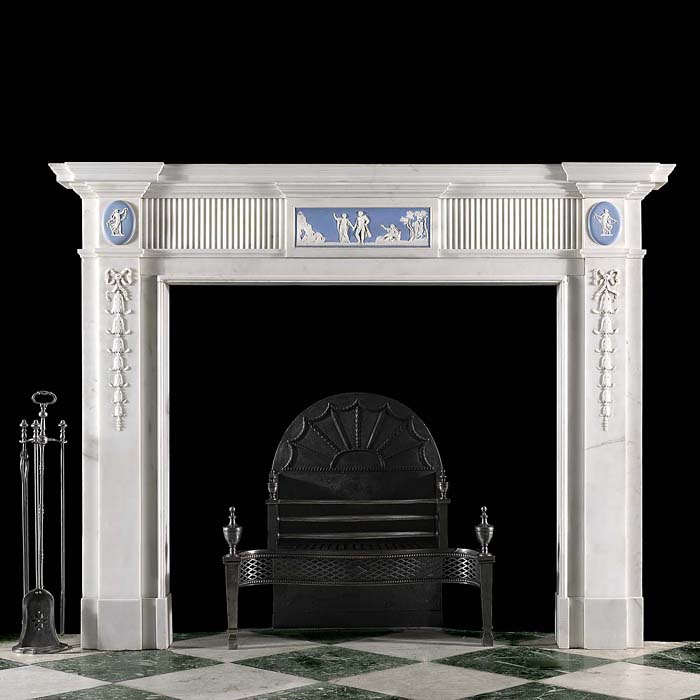
A smart & elegant medium sized White Statuary Marble Chimneypiece in the late Georgian manner, with simple carved fluted frieze panels which flank the central Wedgwood Jasperware plaque showing Hercules with Artemis ? Pan in the background, and oval medallions on the endblocks featuring dancing maidens, with descending bow tied bellflowers carved in low relief on the jambs.
English 1920's.
Link to a section showing full range of similar/related neo-classical chimneypieces
|
Width |
Height |
Depth |
| External |
71 11⁄16"
182 cms |
56 11⁄16"
144 cms |
7 1⁄8"
18 cms |
| Internal |
46 1⁄8"
117 cms |
43 1⁄8"
109.5 cms |
|
-
 Sold
Sold
Stock: 10983
A 20th century carved pine fireplace in the Georgian manner with applied carved floral swags on the frieze centred by a large shell, scrolled carved corbels with descending bellflower carved detail on the jambs.
English, mid 20th century.
Link to a section showing full range of similar/related neo-classical chimneypieces
|
Width |
Height |
Depth |
| External |
59 13⁄16"
152 cms |
48 7⁄8"
124.3 cms |
7 1⁄4"
18.5 cms |
| Internal |
40 3⁄8"
102.5 cms |
36 3⁄16"
92 cms |
|
-
 Sold
Sold
Stock: 10978
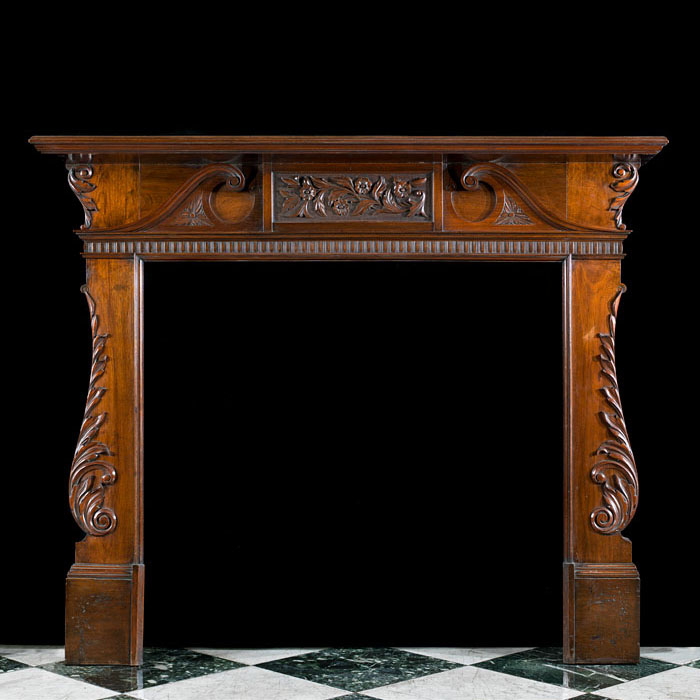
A carved walnut Edwardian fireplace in the Palladian manner with large carved Vitruvian scrolls on the frieze flanking a central floral plaque supported on shaped acanthus carved jambs above large foorblocks.
English, circa 1900.
Link to a section showing full range of similar/related neo-classical chimneypieces
|
Width |
Height |
Depth |
| External |
61"
155 cms |
51 5⁄8"
131 cms |
11 3⁄8"
29 cms |
| Internal |
42 1⁄8"
107 cms |
40 3⁄16"
102 cms |
|
Georgian and Neoclassical fireplaces
Our collection of antique Neoclassical and Georgian fireplaces, chimneypieces and mantels comprises an impressive range in marble, wood and occasionally stone. Whether you wish to complement an existing Georgian or Neoclassical interior or add a touch of period style to a modern room, our Georgian and Neoclassical fireplaces are a great way to make a statement.
The Georgian Era
The Georgian era was a fascinating moment in British Art, Architecture, Design and Culture. This period saw the foundation of the Royal Academy of Art and the British Museum, and nurtured some of the finest architects, Robert Adam, John Nash and John Soane. The Georgian monarchy was a Hanoverian one; founded when the protestant George I ascended to the throne following the death of Queen Anne, his cousin. This Hanoverian monarchy ruled at a time of enormous colonial expansion, economic instability and even saw the birth of the Industrial Revolution. Despite the political and social unrest, the royal family were voracious patrons of the arts, and can be credited with nurturing some of the finest design talent of the time, including the revered architect and designer, Robert Adam.
Period Design Features
There was such a broadening and oscillation in artistic style during this period that it is perhaps more accurate to speak of “Georgian styles.” Palladianism, Neoclassicism and the English Rococo all thrived during the eighteenth-century. The overriding sense was a withdrawal from the heavy opulence of the Baroque style. Classical restraint was certainly favoured; symmetry, proportion and elegance were esteemed characteristics of the period. This was in part due to the popularity of the Grand Tour which highlighted some of the greatest sights of antiquity, and provided invaluable inspiration for both the patrons and designers of the 18th century.
Georgian Fireplaces
The Georgian fireplace embodied the favoured architectural characteristics of the period. Classical proportion and features evocative of Greek and Roman architecture were employed to create a grand and elegant focal point in the Georgian home. The Georgian period is often applauded for its development of domestic architecture also; vast swathes in cities and towns were being redeveloped with elegant terraces and villas, each with their own chimneypieces.
A revolution in Georgian fireplace design
Robert Adam was a seminal figure of the 18th century, and it is perhaps his designs for chimneypieces which are most well-known. Adam had studied in Rome and when he returned to Britain in 1758, opened up an architectural practice with his brother James, becoming the leading figure of the classical revival. The firm’s movement away from the rigid Palladianism of the late 17th century led to a lighter, more whimsical classical style. Their firm was not limited to architecture alone; it produced finished interiors using furniture and fittings of their design. As leading architects to Britain’s aristocracy and royalty, they also sought to show that good, harmonious design had a wider civic purpose. The Adam brothers sought democratise taste with a number of ambitious civic projects.
Adam style fireplaces
Adam fireplaces are instantly recognised by their crisp classical motifs carved in low relief in the form of central tablets and endblocks, and pilastered or columned jambs. Their elegance, designed to complement the finest architecture, is unquestionable
The firm also pioneered a pine and composition chimneypiece which is now an iconic part of 18th century design. This composition was made from a secret recipe and could be applied to wooden frames and treated with a number of finishes, such as gilt, paint, and faux marble. It meant that decorative chimneypieces could be manufactured far more quickly than the traditional limewood or marble chimneypieces, allowing the firm to keep pace with the rapid rate of house construction. They were also more affordable, and allowed more modest homes to enjoy the classical styles, which had been before, the preserve of the elite.
The Neoclassical
The neoclassicism typified by Adam style fireplaces evolved as a response to the flamboyant and opulent designs of both the Rococo and Baroque periods. Use of classical motifs was also intrinsically linked to the ideals of the Enlightenment, as classical design conveyed ideas of knowledge and truth. The style was born in Rome in the mid-18th Century after the rediscovery of Pompeii and Herculaneum, and was circulated throughout Europe by a generation of wealthy Grand Tourists and artists, who returned from their Grand Tours in Italy with freshly discovered Greco-Roman ideals.
Neoclassicism favoured a more formal, dignified approach that respected order and decorum, and established rules that became a distinct movement in the decorative and visual arts, literature, theatre, music and architecture throughout northern Europe from the mid-18th to the end of the 19th centuries. It still endures as one of the most popular architectural styles today.
Related periods
If you are drawn to later, more ornate styles, our Victorian fireplace collection is a natural next step from the Georgian period.