Antique Armchair Styles By Period: Our Guide
07 October 2026
Anthony Bridgman
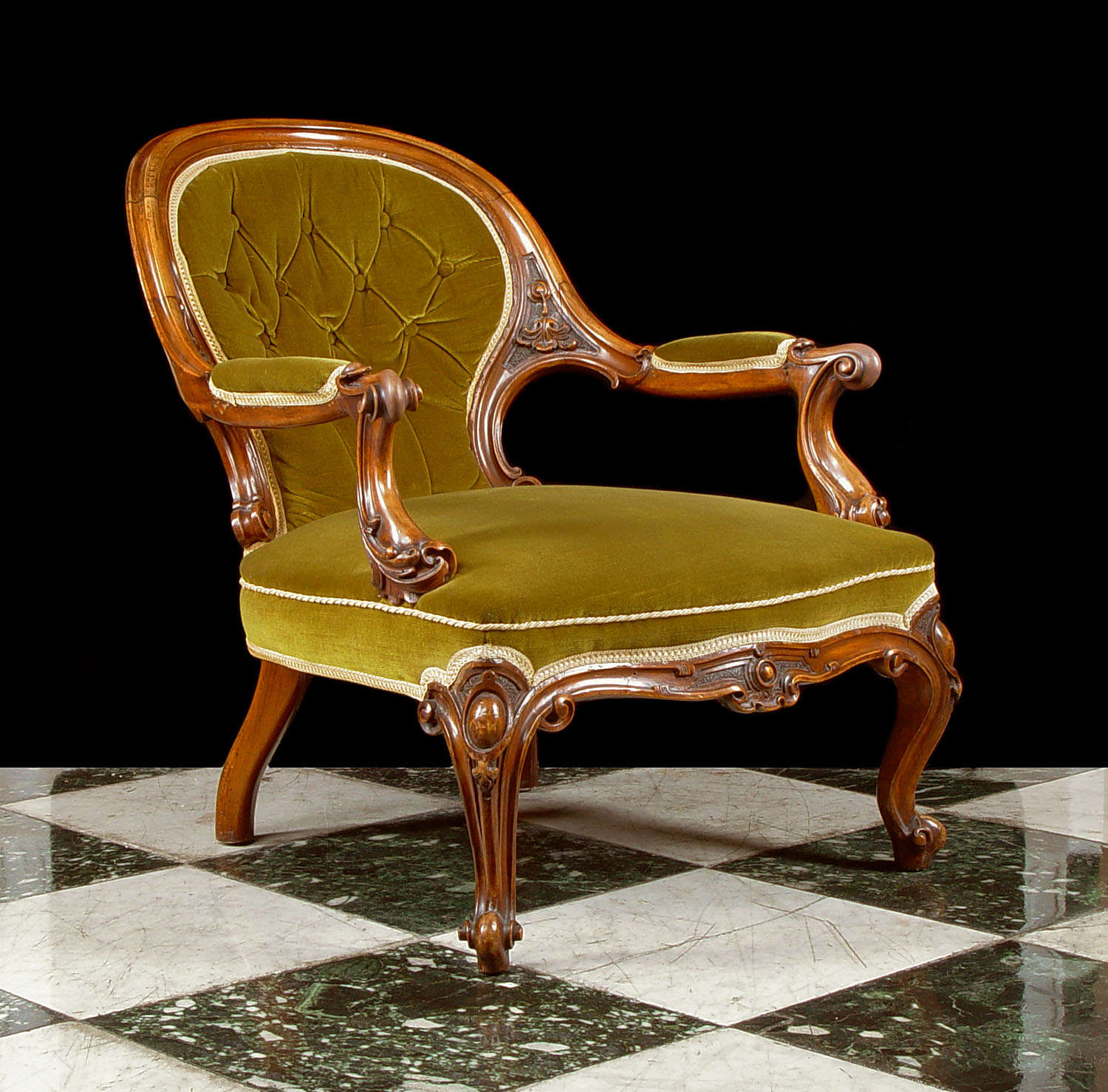
This in-depth article covers how antique armchair styles have changed over time, from the Gothic period to the Art Deco era.
Summary: Antique armchair styles by period
Early periods, from Medieval and Tudor through to Jacobean, are characterised by substantial oak frames, high backs, carved panels and formal construction.
From William and Mary to Georgian and Neoclassical styles – walnut and mahogany, cane work, cabriole legs, refined carving and classical symmetry became increasingly fashionable.
Victorian and later 19th-century chairs prioritised comfort while embracing upholstery and revival styles, while the Aesthetic and Arts & Crafts movements offered lighter, simpler alternatives.
Medieval / Gothic c.1100-1485
Main armchair types: Faldstool or X-frame chair, high-backed seigneurial chair.
Grand chairs during this time, tall and usually made of wood, were usually symbols of status and authority such as for the nobility or royalty.
For example, a seigneurial chair was a heavy, paneled wooden armchair with a tall back, occasionally topped with a canopy. A folding X-frame chair was portable seating for wealthy households and ceremonial occasions.
The common man or woman often had to make do with a bench, chest or stool. Benches were common in medieval and Tudor houses, with a solid base to keep your feet off the cold floors and space to store household items.
Tudor c.1485-1558
Main armchair types: Joined armchair, Wainscot chair, X-frame chair.
Joined armchairs were those built by a professional ‘joiner’ using mortise and tenon joints they locked together with wooden pegs.
One type of these chairs, the wainscot, became an important Tudor status symbol. It was a huge, imposing oak chair usually at the head of a dining table.
X-frame chairs continued in use. Henry VIII had several X-frame chairs which were heavily cushioned and draped in expensive velvet, silk or gold fabrics covering the wooden frame.
Elizabethan c.1558-1603
Main armchair types: Wainscot chair, turned armchair, X-frame chair.
Elizabethan armchairs were usually made of oak and remained symbols of wealth and authority, often with tall panelled backs, arms and elaborate carved details.
Wainscot chairs continued to be popular in great houses and formal rooms, with carved panels, bold crest rails and Renaissance-inspired decoration such as strapwork, foliage, masks and columns.
Turned armchairs became more fashionable during this period with frames built from shaped, lathe-turned spindles or stretchers and a more decorative appearance than solid wainscot chairs.
Jacobean / Carolean c.1603-1700
The early Jacobean armchairs maintained the sturdy, upright appearance of Elizabethan ones.
Main armchair types: Wainscot chair, turned armchair, caned armchair.
The early Jacobean armchairs maintained the sturdy, upright appearance of Elizabethan ones.
They were usually made of oak with square frames, carved panel backs, turned legs and stretchers. Also, turned chairs became increasingly popular.
Read our article on the Jacobean era: a guide to designs, interiors and furnishings for more details.
Following the Restoration of Charles II in 1660, the Carolean furniture became lighter and more luxurious. Increasingly, walnut replaced oak, while cane backs and seats, veneers, tapestry and velvet upholstery reflected influences from the French, Dutch and Flemish.
By the end of the 17th century, armchairs were beginning to move away from mainly formal status seats to becoming more domestic furniture.
William & Mary c.1689-1702
Main armchair types: Caned armchair, high-back armchair, open armchair.
William and Mary armchairs were lighter and more refined than earlier Jacobean and Carolean ones. Walnut was more fashionable now rather than heavy oak.
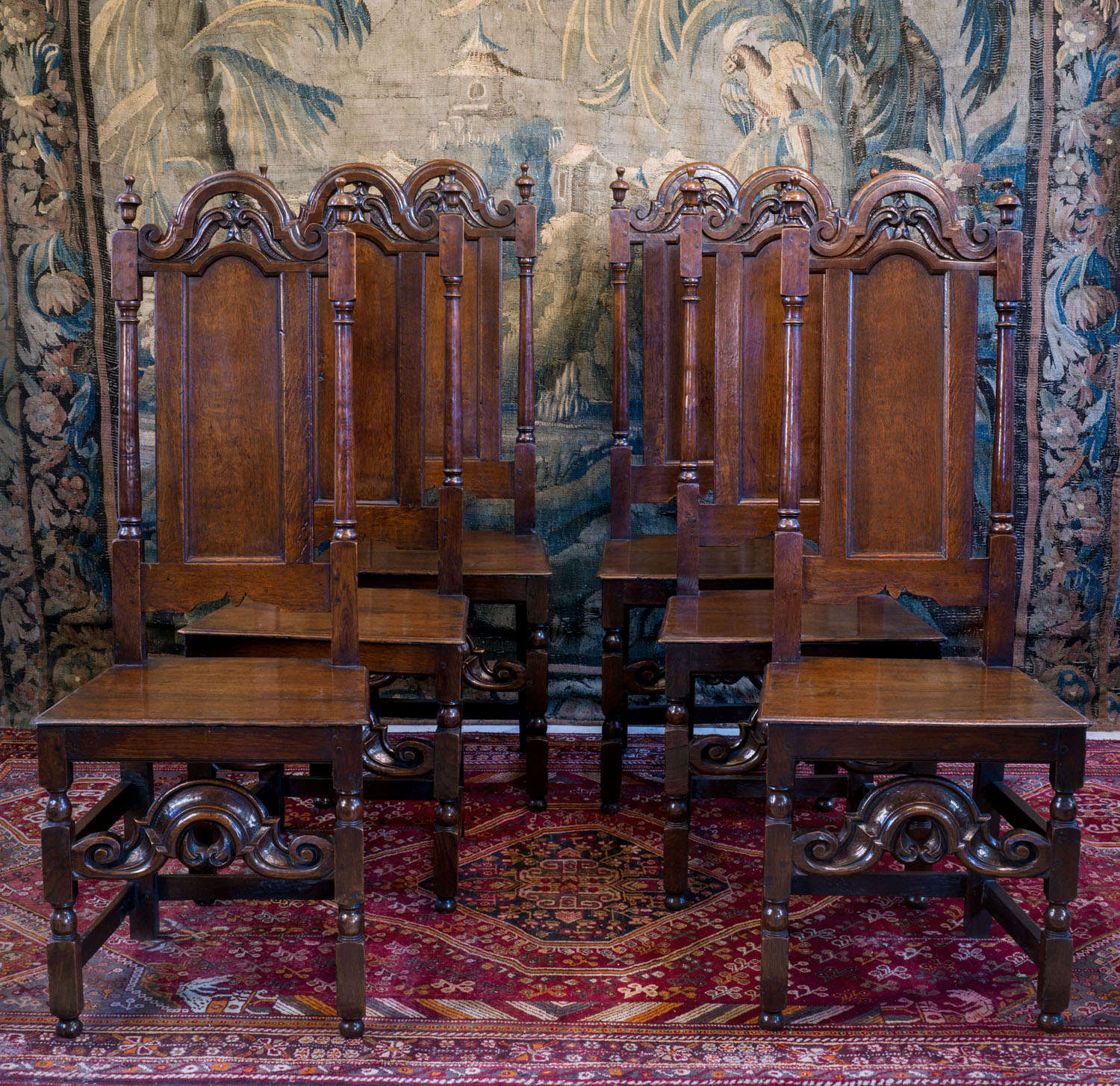
Above you can see a rare set of six William and Mary high-backed dining chairs c.1690. Now sold, these are great examples of the walnut chairs with caned backs popularised in the late 17th century.
Queen Anne c. 1702-1760
The defining furniture feature of the Queen Anne period was arguably the cabriole leg: an elegant S-shaped leg that curves outward at the knee and inward towards the foot.
Main armchair types: Cabriole-leg armchair, wing chair.
Queen Anne armchairs tended to be more graceful and comfortable than the high-backed ones of the late 17th century. Walnut was especially fashionable early in the period, followed by mahogany once it became more widely available.
The defining furniture feature of the Queen Anne period was arguably the cabriole leg: an elegant S-shaped leg that curves outward at the knee and inward towards the foot.
It was often finished with a simple pad foot, although more elaborate examples could have a claw-and-ball foot. Find out more about how to date antique furniture by feet.
Wing chairs, designed to shelter the sitter from draughts beside a fire, became popular too. They had tall upholstered backs, projecting side wings and seat cushions for comfort.
French Rococo / Louis XV c.1730-1775
Main armchair types: Bergère, fauteuil, fauteuil à la reine.
Compared with English Queen Anne furniture, Louis XV chairs were generally more decorative and free-flowing.
Both may use cabriole legs, but French Rococo examples tended to have more pronounced curves, elaborate carving and generous upholstery.
Bergère chairs had an upholstered back and arms, sometimes with enclosed sides. Fauteuils were upholstered with open sides, in contrast to most bergère chairs. A fauteuil à la reine had a flatter, more upright rectangular back designed to stand against a wall.
Read our guide on antique French furniture and Rococo interior design for more details.
Georgian / Chippendale c.1750-1780
Main armchair types: Chippendale armchair, library armchair, open armchair, wing chair.
No discussion of Georgian furniture is complete without mentioning Thomas Chippendale, 1718-1779, one of the most influential English designers ever. Learn more about Chippendale style furniture.
Chippendale armchairs often had carved backs, shaped arms and cabriole legs, sometimes ending in claw-and-ball feet. His early designs in particular drew on Rococo, Gothic and Chinese styles but from the 1760s, he was influenced by the Neoclassical architecture of Robert Adam.
Mahogany became the wood of choice for finer pieces, valued for its strength, rich colour and suitability for detailed carving.
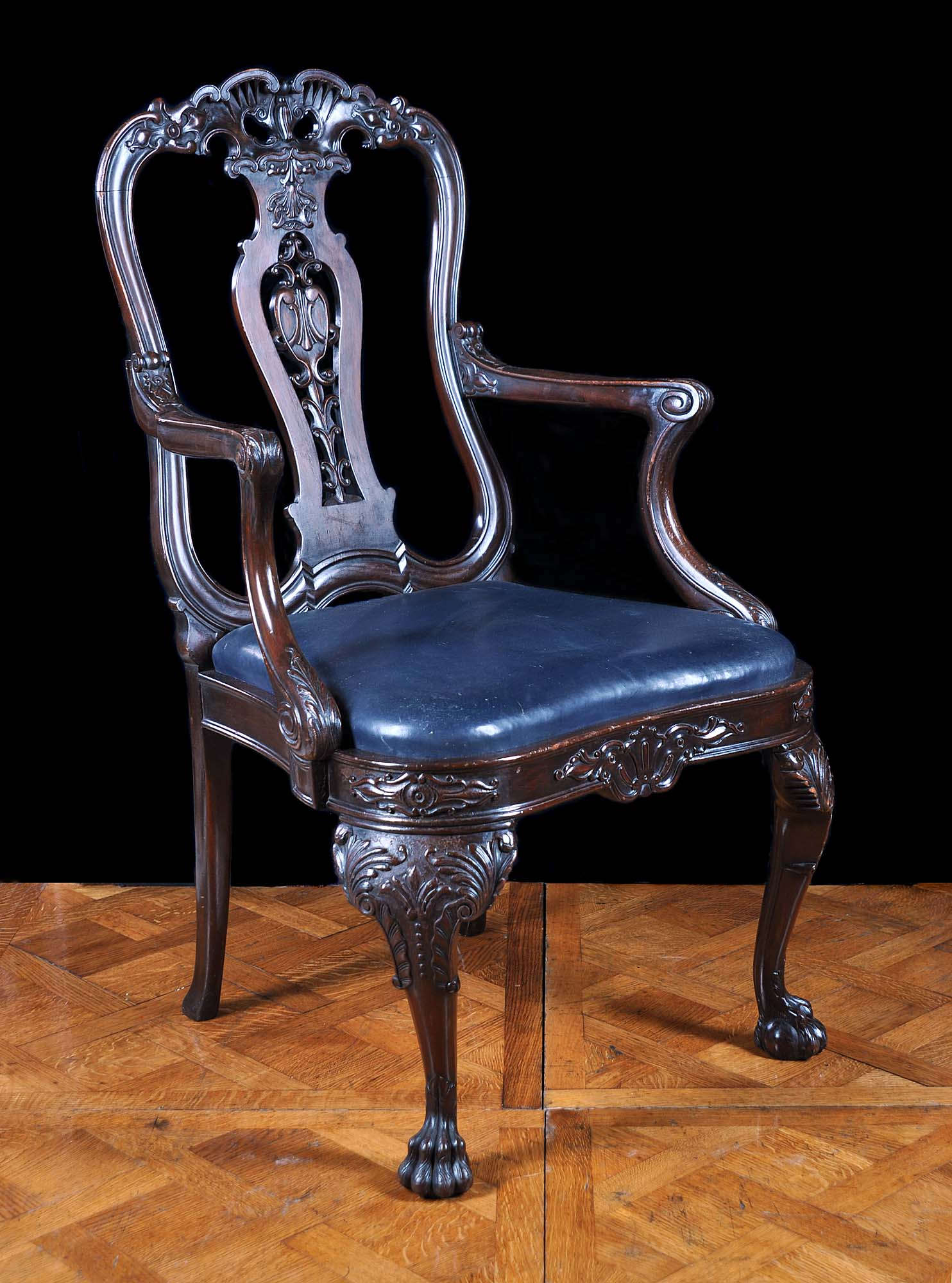
Above is a carved Chippendale style mahogany armchair. The blue leather upholstered seat is flanked by scrolled arms, descending to ornate florally carved cabriole front legs with claw-and-ball feet.
Neoclassical c.1775-1820
Main armchair types: Hepplewhite shield-back armchair, Sheraton armchair, oval-back chair.
The style of the time was inspired by a renewed interest in classical architecture and design.
Following on from Chippendale, this period is known for the contributions from the remaining ‘big three’ English furniture makers George Hepplewhite, 1727-1786 and Thomas Sheraton, 1751-1806.
Hepplewhite-style armchairs often had shield-shaped or oval backs, slender arms and elegant tapered legs.
Sheraton chairs were generally more rectilinear and refined, with square or rounded tapering legs and decorative painted or inlaid details. Read more about Thomas Sheraton furniture.
Regency c.1810-1840
Main armchair types: Klismos chair, Grecian armchair, tub chair, library armchair.
Regency armchairs continued the classical influence of Neoclassical design but were generally bolder, more dramatic and more luxurious.
Mahogany remained popular, often enriched with brass mounts, painted decoration or carved ornament. The style took inspiration from ancient Greece, Rome and Egypt with decorative, animal-themed details such as lions’ paws, sphinxes, swans or dolphins.
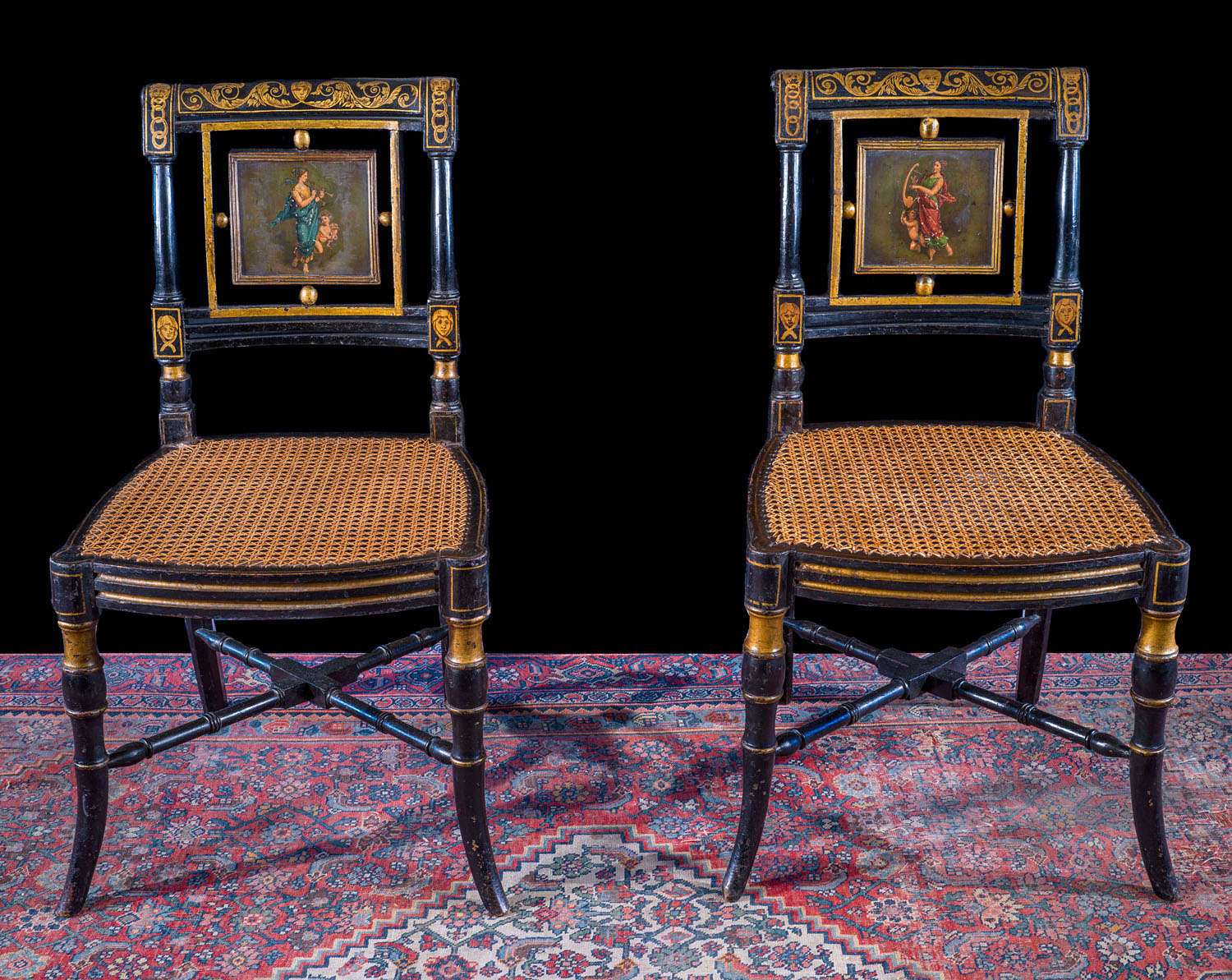
Above is a fine pair of ebonised Regency side chairs, c.1815, now sold, featuring square backs inset with painted panels reminiscent of the domestic Roman frescoes of Pompeii, over caned seats.
Victorian c.1837-1901
Improvements in upholstery made Victorian chairs deeper and softer, while industrial production made a wider range of furniture available to middle-class homes.
Main armchair types: Balloon-back chair, spoonback chair, gentleman’s armchair.
Improvements in upholstery made Victorian chairs deeper and softer, while industrial production made a wider range of furniture available to middle-class homes.
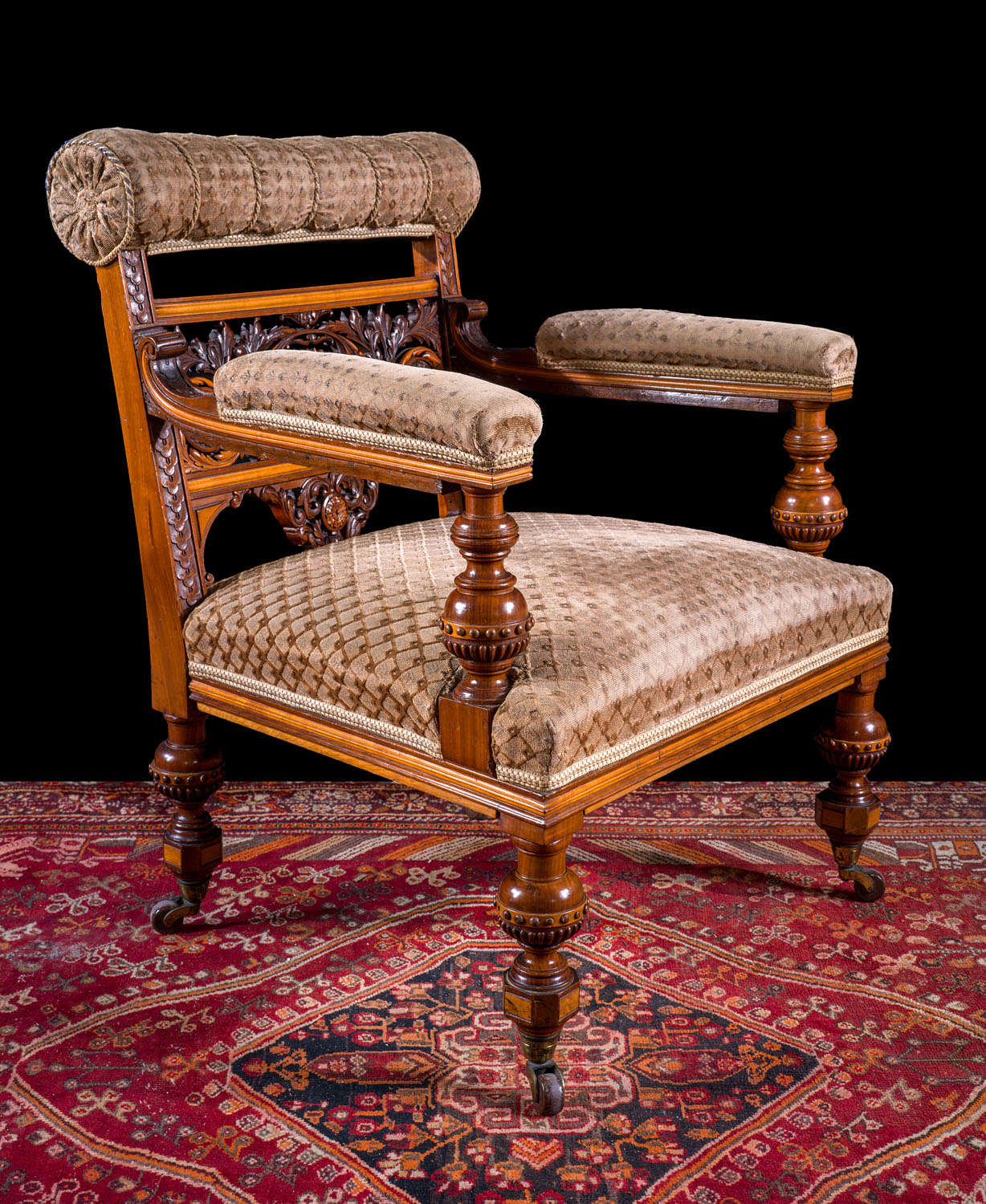
At the top of this article you can see a mahogany Victorian spoonback armchair with deep-buttoned upholstery and sculpted features.
The period drew heavily on earlier styles such as Gothic Revival chairs with pointed arches, tracery and dark carved oak or Rococo Revival with flowing curves, carved flowers and scrolls. Read more about how to identify Victorian furniture.
Above is a highly carved gentleman’s chair, a Victorian walnut and boxwood armchair by Tarn & Co in walnut and boxwood, from c.1860, with upholstered seat and arms for comfort.
Aesthetic Movement c.1860-1900
Armchairs during the Aesthetic Movement were generally lighter and more delicate-looking than the heavily carved Victorian gentleman’s chair.
Main armchair types: Ebonised armchair, bamboo chair, Japoniste armchair.
Armchairs during the Aesthetic Movement were generally lighter and more delicate-looking than the heavily carved Victorian gentleman’s chair.
Ebonised wood, gilding, painted decoration and lacquered surfaces were popular, also Japanese and Chinese-inspired motifs.
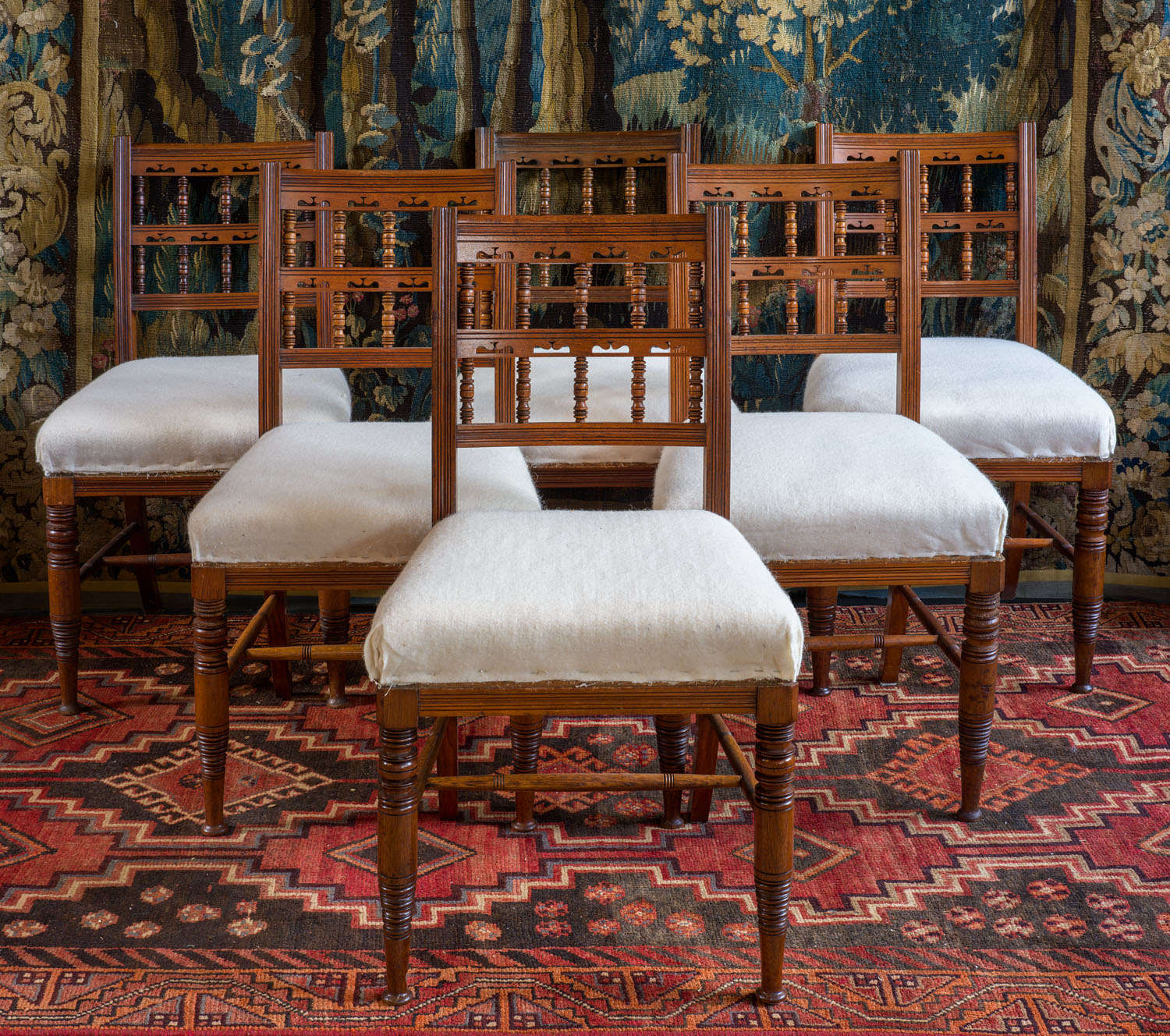
Below is an Aesthetic movement set of six Bruce Talbert for Gillows dining chairs in mahogany. We recently covered the Gillows of Lancaster antiques in our collection.
Arts & Crafts c.1880-1920
Main armchair types: Morris chair, Sussex chair, ladder-back armchair, settle.
Next, what is arts and crafts movement furniture? It was partly as a reaction against the ornate and to some, mass-produced look of much Victorian design.
Armchairs often had square, sturdy frames, straight legs, wide arms and visible joints, with slatted or spindled backs rather than elaborate carving.
The Morris chair, named after William Morris (1834-1896), was a large reclining armchair with an adjustable back and plain wooden frame. Meanwhile the more affordable Sussex chair had a simpler, lighter shape often with turned legs, a spindle back and a rush seat.
Also from this time period, find out more about Art Nouveau and Edwardian furniture design styles.
Art Deco c.1920-1940
Main armchair types: Club chair, cocktail chair, lounge chair.
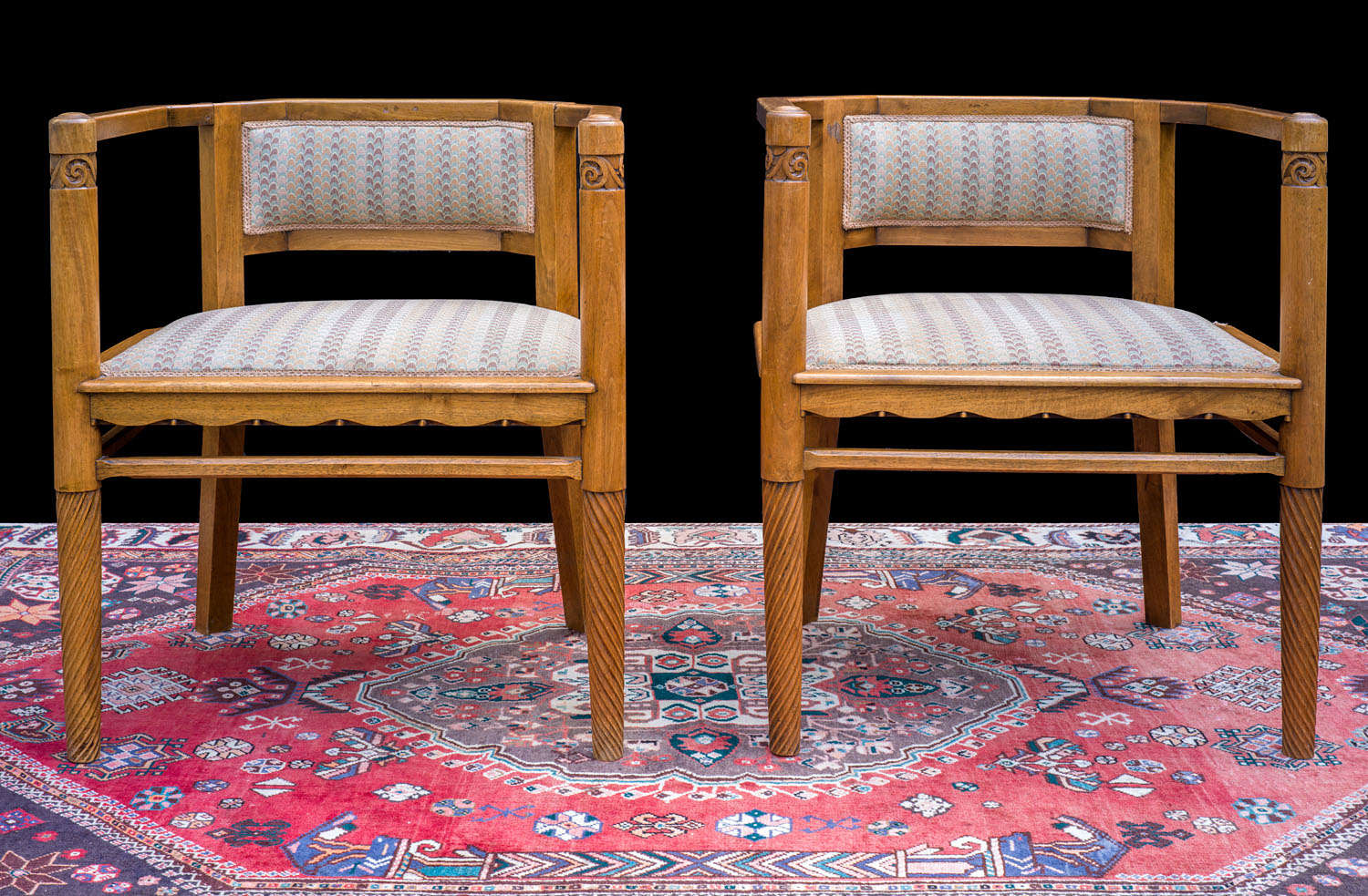
Above is a pair of Italian Art Deco side chairs, c. 1920, showing an early and restrained version of the style.
Their square frame, geometric back rails and symmetrical proportions reflect Art Deco’s move towards simplified modern design.
Art Deco armchairs moved away from the historical revival styles of the Victorian period. They emphasised clean geometry, streamlined curves and an intentionally modern, luxurious appearance.
Final thoughts: Antique armchair styles by period
If you enjoyed this guide, we also recommend learning about how to identify antique chairs by looking for signs of maker’s marks, handmade details, distinctive feet and more.
Whether under the dining table, beside an antique fireplace, by a window or anywhere else, there’s nothing quite like a beautiful antique chair.
For more than 50 years, Westland London has specialised in period chimneypieces, fireplace accessories, lighting, decorations and antique furniture such as armchairs.
If you have a query about anything in our collection of antiques, please don’t hesitate to contact us.