Gillows of Lancaster Antiques In Our Collection
28 July 2026
Gillows of Lancaster, also known as Gillow & Co., is famous for its refined neoclassical style, elegant style and high-quality craftsmanship. Typical features included imported mahogany, clean lines, expert joinery and innovative details at the time, such as secret drawers or telescopic dining tables.
Summary: Gillows of Lancaster
After beginning to trade in 1728, soon Robert Gillow became one of the leading cabinet-makers in Lancaster, with a reputation for manufacturing very high quality furniture.
They were successful in part due to founder Robert Gillow’s ability to import mahogany by ship from the West Indies.
Thomas Gillow opened a shop at 176 Oxford Street in London to sell the firm’s furniture in 1769.
Leonard Redmayne, Whiteside and Ferguson took over the business in 1814, expanding into interior design but continuing to use the Gillow name.
When the business became stretched, the company partnered with Warings of Liverpool. After buying the company in 1903, it became Waring & Gillow – the Lancaster workshops eventually closed in 1953.
Lancaster-based Robert Gillow began trading as a builder, carpenter, furniture maker and overseas merchant in 1728.
18th century: Origins in Lancaster
Lancaster-based Robert Gillow began trading as a builder, carpenter, furniture maker and overseas merchant in 1728.
With six members of staff by 1735, he found success through the heavy use of mahogany wood. At the time, this was indigenous to the Americas, but he had a share in a ship which let him import the wood from the West Indies.
Robert formed an equal partnership with his son Richard Gillow in 1757, creating Robert Gillow & Son. Then in 1768, he retired and left his share of the company to his son Robert Gillow II – the Lancaster branch had 42 employees by 1775.
The brothers’ cousin, Thomas Gillow, had set up a shop at 176 Oxford Street in London by 1770 to sell their furniture. Today, the flagship H&M store is located there.
19th century: Leonard Redmayne, Whiteside and Ferguson
Leonard Redmayne took over the business in 1814 in partnership with Whiteside and Ferguson – but they continued to use the Gillow name.
Redmayne became mayor of the City of Lancaster in 1824 and the first chairman of the Lancaster Banking Company, which would eventually form part of NatWest.
During the 19th century, Gillow & Co. expanded from furniture design and manufacture to interior design, the largest company of its type outside London.
With a strong reputation, they provided furniture for aristocratic houses, as well as furnishing and decoration for public buildings around the world in the United States, Europe, Asia and Australasia.
During the 19th century, Gillow & Co. expanded from furniture design and manufacture to interior design, the largest company of its type outside London.
20th century: Waring & Gillow
However, by 1897, the company was stretched. It made an informal partnership with Warings of Liverpool, which then bought the business in 1903 to become Waring & Gillow.
During the First World War, the Lancaster factory prioritised military production, including ammunition chests for the Navy and aircraft propellers, as well as ammunition belts for machine guns.
The company ran into financial trouble during the Great Depression of the 1930s – it went through a liquidation and restructuring in 1932.
Waring died in 1940, early into the Second World War and ultimately, Great Universal Stores bought the business in 1953.
Gillows of Lancaster antiques in our collection
Thuya ebonised sideboard
This is a beautiful, small Japanese-style Gillow & Co Thuya and ebonised sideboard from c.1870.
Gillow & Co 12296 is stamped on the top of one of the drawers.
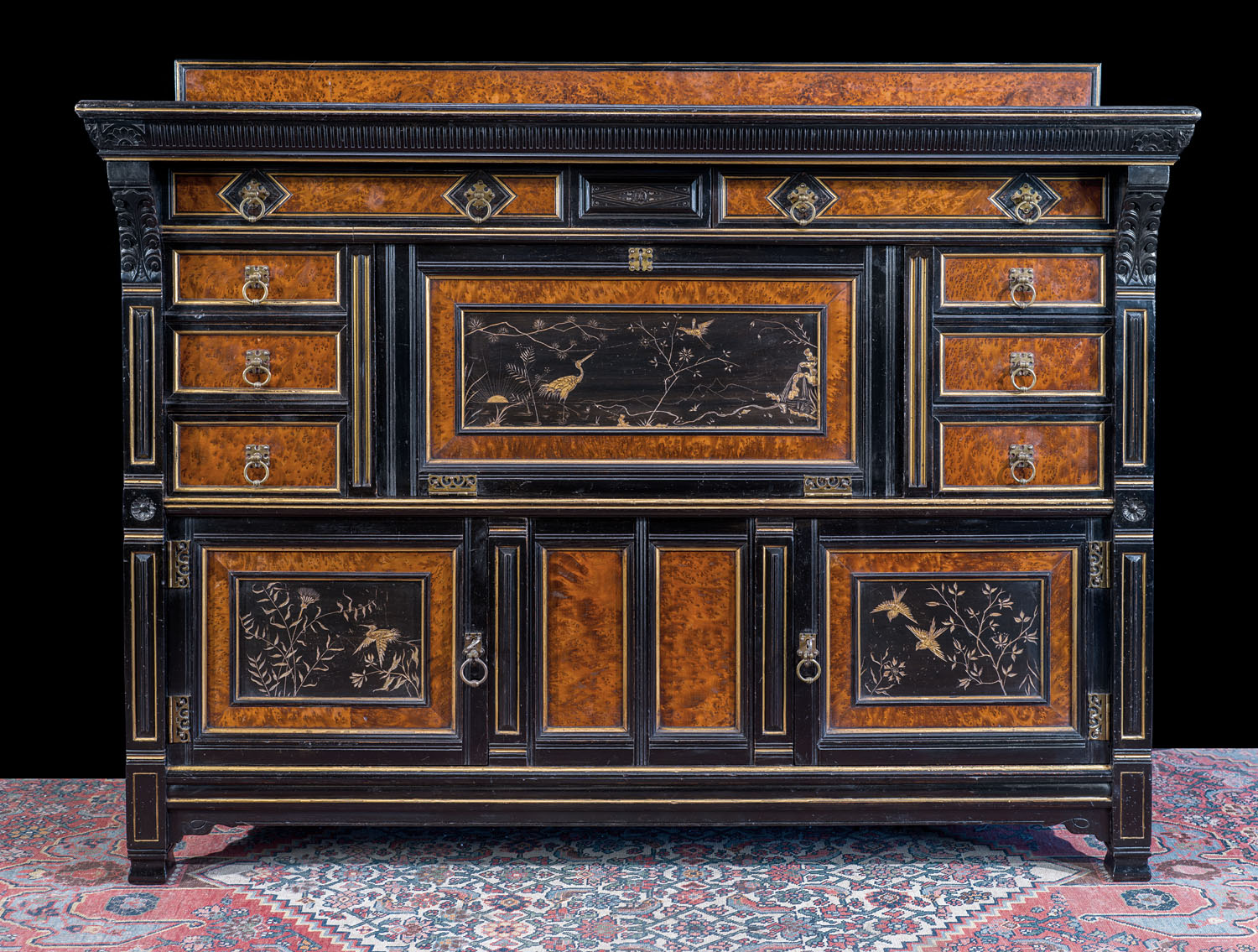
It is an ebonised and gilt wood sideboard with Thuya veneered panels and top. The central pull down door has a delicately carved and gilded Japanese scene of a stylised landscape, featuring trees and birds.
There are two sets of three Thuya fronted drawers, with original brass handles and two long drawers above. In the lower half of the cabinet, there is another pair of doors decorated with Japanese style foliage and birds.
Bronze art nouveau exhibition panels
Here is a stunning, enormous pair of bronze art nouveau Gillow exhibition panels.
These likely featured in grand display stands at one of the great international exhibitions, probably either the London Exhibition of 1908 or the one in Ghent in 1913.
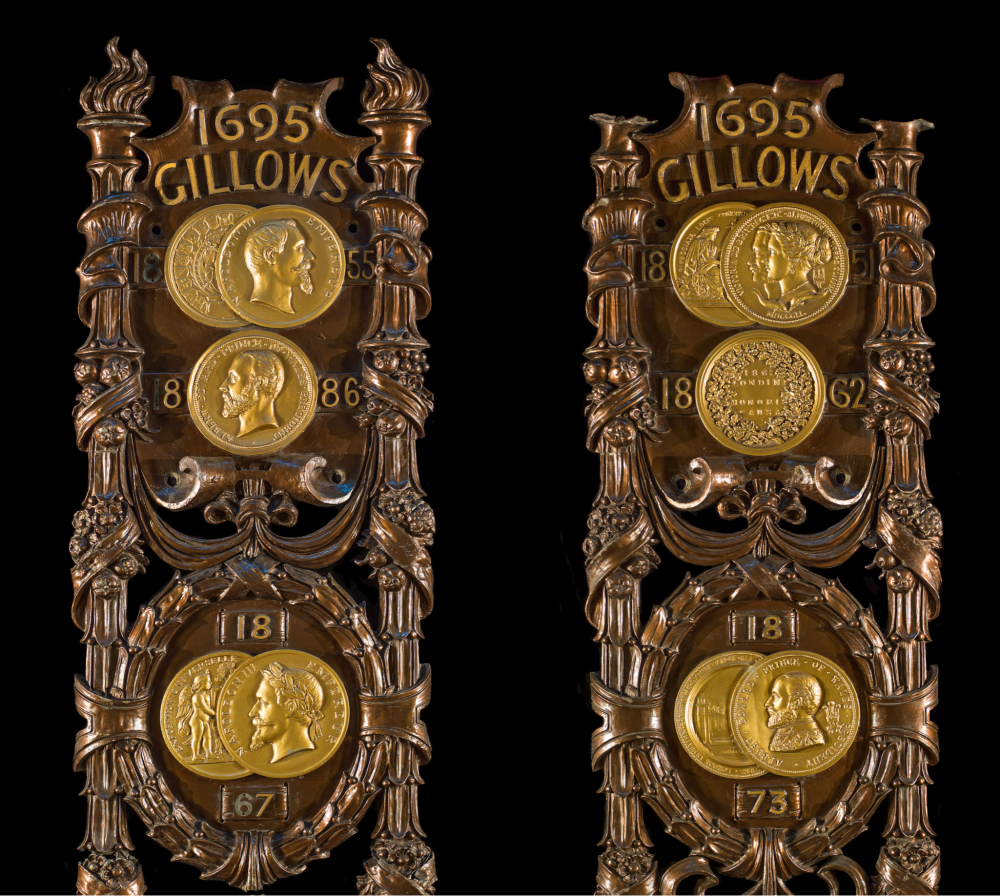
The panels feature medallion copies of medals awarded to Gillows at various exhibitions, such as London in 1851 and Paris 1900.
The panels feature medallion copies of medals awarded to Gillows at various exhibitions, such as London in 1851 and Paris 1900.
They were found in a dockside warehouse in Liverpool, home to the Warings.
Aesthetic movement walnut fire surround
This is an Aesthetic movement walnut fire surround probably manufactured by Gillows of Lancaster, as they provided the original furnishings for the property in Windemere where this fireplace used to be.
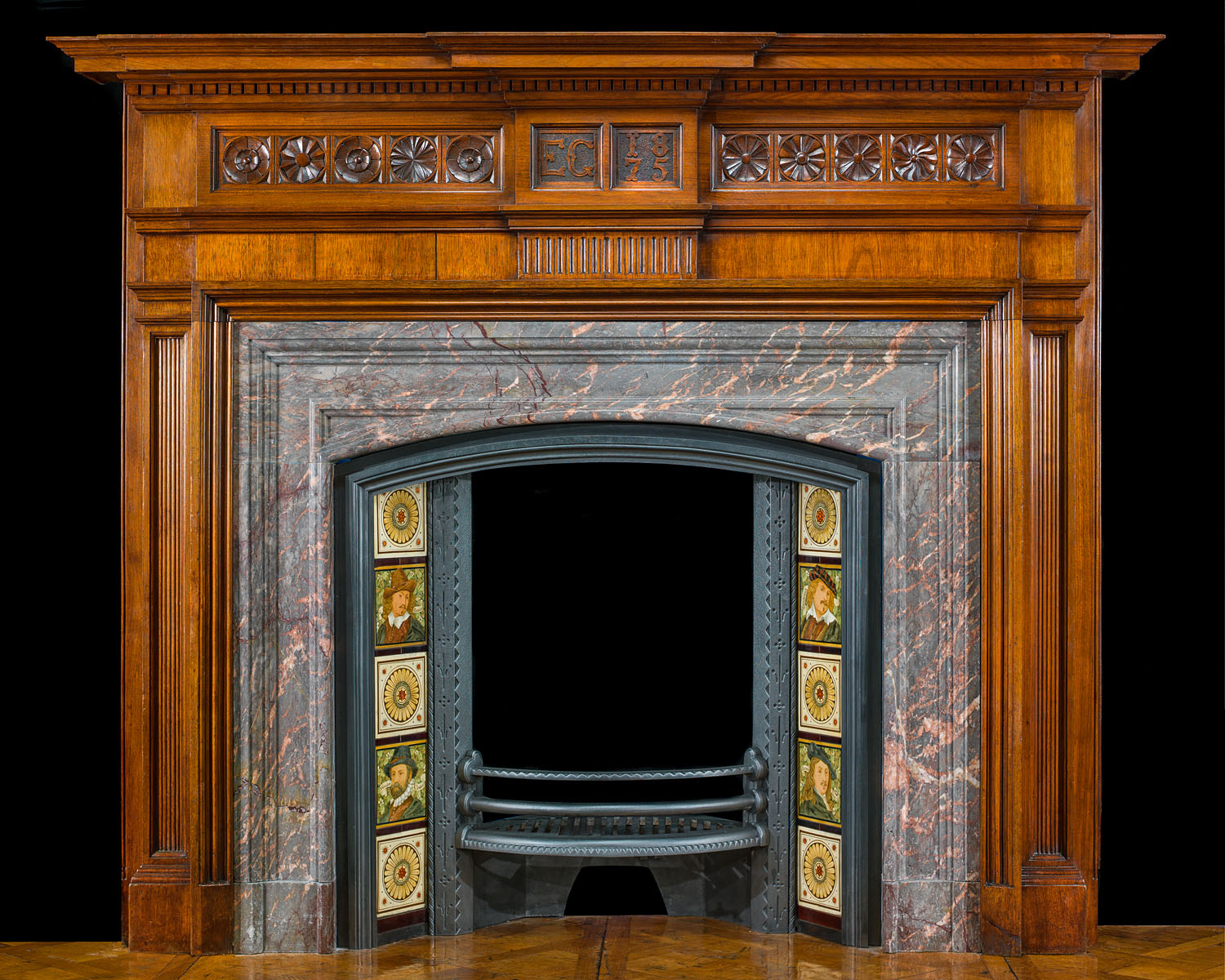
It has a breakfront shelf above a frieze with alternating rosette panelled designs, centred by the initials EC and the date 1875.
The register grate has ten hand painted tiles, four of which depict 17th century Dutch Painters, all of whom were of the Dutch Realist School of Genre Painting in Utrecht, Delft and Leiden or Amsterdam.
Find out more in our dedicated guide – Delftware Guide: Including How To Identify Delft Pottery Marks.
Gillow and Co. notable contributions and legacy
As an architect, Richard Gillow designed Lancaster Custom House in 1764.
He also financed the building of Lancaster Cathedral in 1798.
Gillow & Co. provided more than 200 pieces of furniture for Tatton Hall in Cheshire, starting from the late 1700s and continuing into the early 1800s.
The Gillow family also bought and later remodelled Leighton Hall in Lancashire.
Early in the 20th century, Samuel James Waring’s building company built the Selfridges department store and Ritz Hotel in London.
The Gillow archives are one of the largest collections of cabinet-maker records, but they were never fully published.
Some believe that George Hepplewhite, one of the ‘big three’ English furniture makers, began working as an apprentice to Robert Gillow in the 1750s, but others dispute this.
The Gillow archives are one of the largest collections of cabinet-maker records, but they were never fully published.
Final thoughts: Gillows of Lancaster antiques
You can identify Gillows pieces through stamps such as “Gillow’s Lancaster”, “Gillow & Co. Lancaster”, and “Gillow” – then later, “Waring & Gillow”.
These stamps are usually under tabletops, inside drawers or on chair frames, sometimes alongside serial numbers or other marks.
If you enjoyed this guide, you may like some of our other most popular articles, such as:
Westland London has specialised in period chimneypieces, fireplace accessories, furniture, lighting, decorations and a wide range of other stunning architectural antiques for more than 50 years.
If you have any queries about our antique fireplaces or anything else in our collection, please don't hesitate to contact us.